How to Get Your Business Recommended by ChatGPT, Google AI Mode & Perplexity in 2026
Learn how to improve your business visibility in ChatGPT, Google AI Mode and Perplexity using crawl access, SEO, structured data, useful content and trust signals.
Your website ranks on Google. Your Google Business Profile is active. Your services are clearly listed.
But what happens when a potential customer skips the traditional search results and instead asks:
“Which web development company can build a business website in Mumbai?”
“Which SEO agency can help my local business?”
“What is a reliable digital agency for a growing Indian business?”
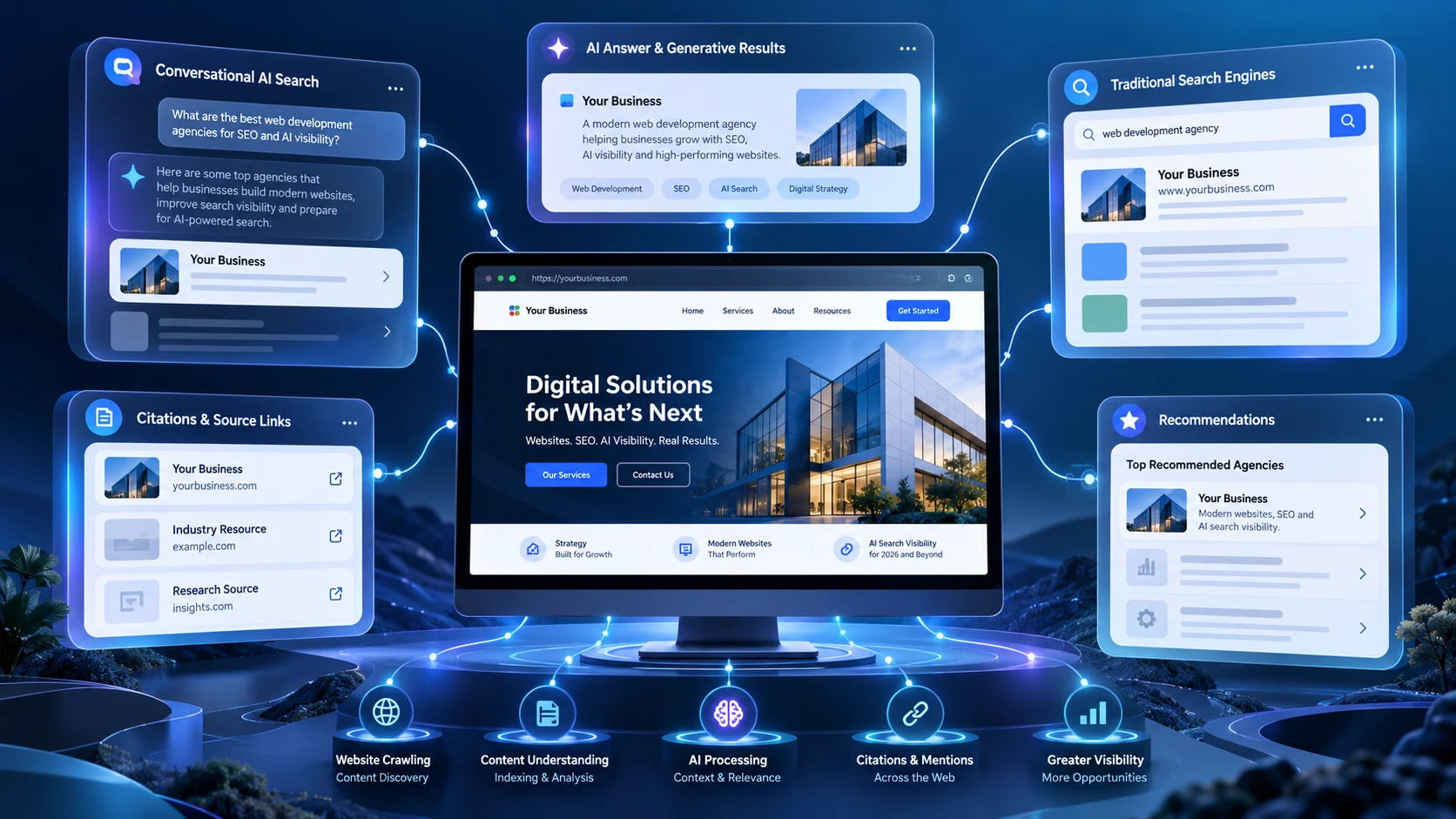
Increasingly, questions like these are being asked through conversational search experiences such as ChatGPT, Google AI Mode, AI Overviews and Perplexity.
For businesses, that creates a new visibility challenge.
It is no longer only about ranking a page for a keyword. Your business also needs to be easy for search and AI systems to discover, understand, verify and reference.
This guide explains what businesses can realistically do in 2026 to improve their visibility across AI-powered search—without relying on questionable “AI ranking hacks,” fake guarantees or unnecessary technical gimmicks.
Quick Answer: How Do You Get Your Business Recommended by ChatGPT and AI Search?
There is no form that guarantees your business will be recommended by ChatGPT, Google AI Mode or Perplexity.
The practical approach is to make your website technically accessible, clearly explain what your business does, publish genuinely useful information, maintain consistent business details, use accurate structured data, build strong internal relationships between pages and develop a credible presence across the wider web.
For ChatGPT specifically, OpenAI documentation explains that public websites can appear in ChatGPT Search and recommends allowing its OAI-SearchBot crawler if you want your content to be discoverable, cited and linked in search experiences.
For Google, there is no separate “AI ranking system” that website owners need to optimize through special files or special AI schema. In Google's official AI search documentation, Google states that the same foundational SEO practices used for Search remain relevant to AI Overviews and AI Mode.
Perplexity similarly operates a crawler called PerplexityBot, which Perplexity crawler documentation recommends allowing when a site wants to be surfaced and linked in Perplexity search results.
The objective is therefore not to “trick AI.”
The objective is to become an easy-to-understand, well-supported answer to the questions your potential customers are already asking.
What Does “Getting Recommended by AI” Actually Mean?
AI visibility can happen in several different ways.
Your website might be cited as a source inside an AI-generated answer. A particular service page might appear as a supporting link. Your company may be mentioned when a user asks for providers in a specific category or location. An educational article from your website might be referenced without your company being directly recommended.
These are different outcomes.
That is why businesses should avoid thinking about AI visibility as one universal ranking position.
Traditional Google Search often gives marketers a familiar framework such as rankings, impressions, clicks and positions.
Conversational search is more contextual.
A business might appear for:
“website development companies in Mumbai”
but not appear for:
“best Laravel development company for an e-commerce project.”
The second question contains different requirements, which can cause the system to retrieve and evaluate a different collection of information.
In its technical overview of generative search, Google Search Central confirms that generative AI experiences such as AI Mode and AI Overviews can use a technique called query fan-out, where multiple related searches are issued to gather information across different aspects of the original question.
This changes how businesses should think about content.
A page should not simply repeat one target keyword.
It should help answer the connected questions surrounding the customer's actual decision.
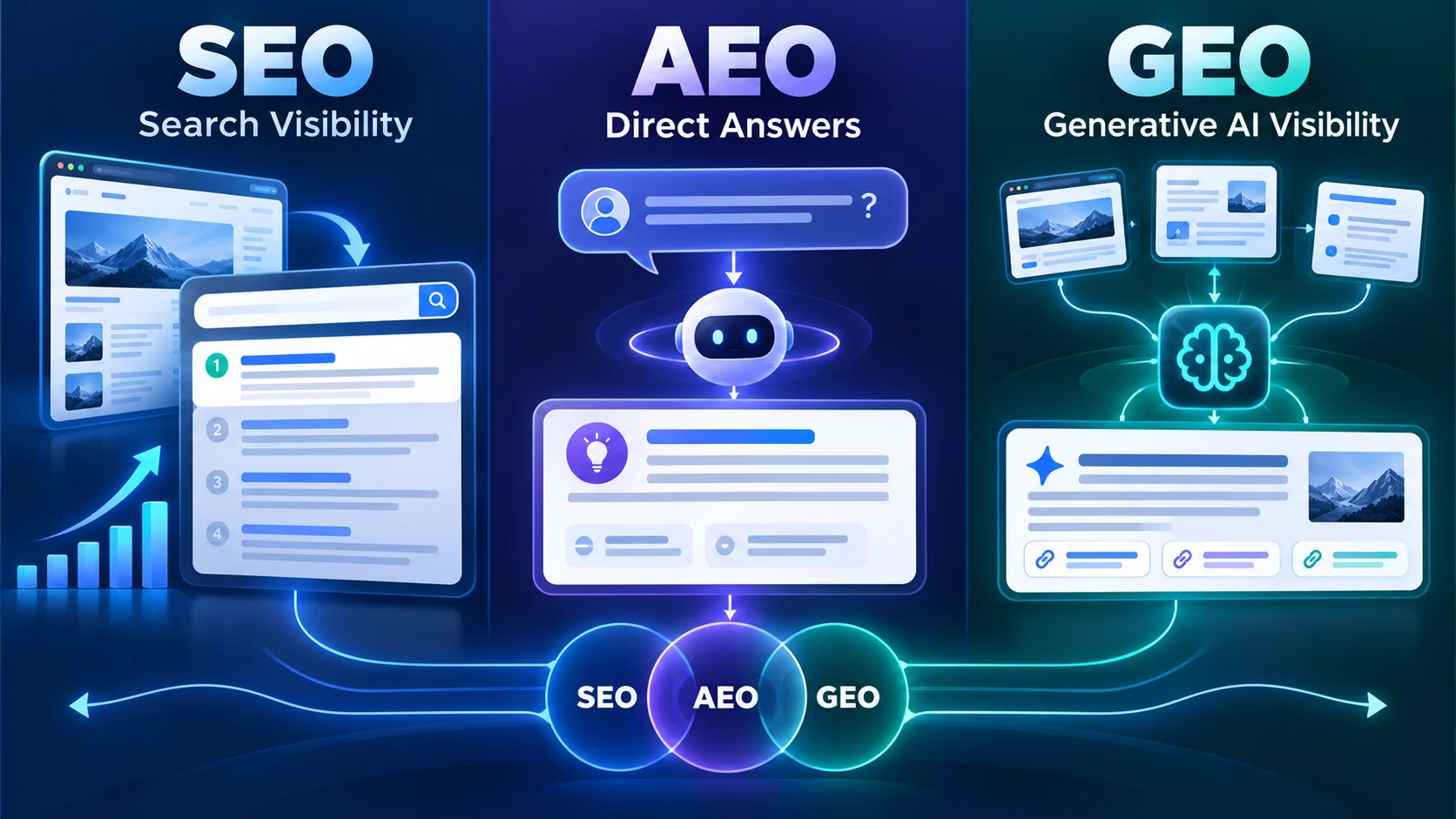
SEO vs AEO vs GEO: What Is the Difference?
The terminology around AI search has become unnecessarily complicated.
A useful way to understand the three terms is:
| Approach | Main Goal | Practical Focus |
|---|---|---|
| SEO — Search Engine Optimization | Improve organic search visibility | Crawlability, indexing, content, relevance, site structure, internal links, authority and user experience |
| AEO — Answer Engine Optimization | Make information easy to answer directly | Clear questions, concise answers, definitions, FAQs, structured information and factual copy |
| GEO — Generative Engine Optimization | Improve visibility in generative search experiences | Clear entities, useful source material, factual consistency, crawl access, supporting evidence and wider-web visibility |
These areas overlap significantly.
In its official advice on modern search, Google Search Central emphasizes an important point: from Google's perspective, improving visibility in generative AI Search is still fundamentally an extension of good SEO rather than an entirely separate discipline.
For most businesses, this means the correct strategy is not:
SEO or GEO or AEO.
It is:
Build strong SEO foundations, then structure and strengthen the information so both people and modern answer systems can understand it easily.
1. Make Sure AI and Search Crawlers Can Access Your Website
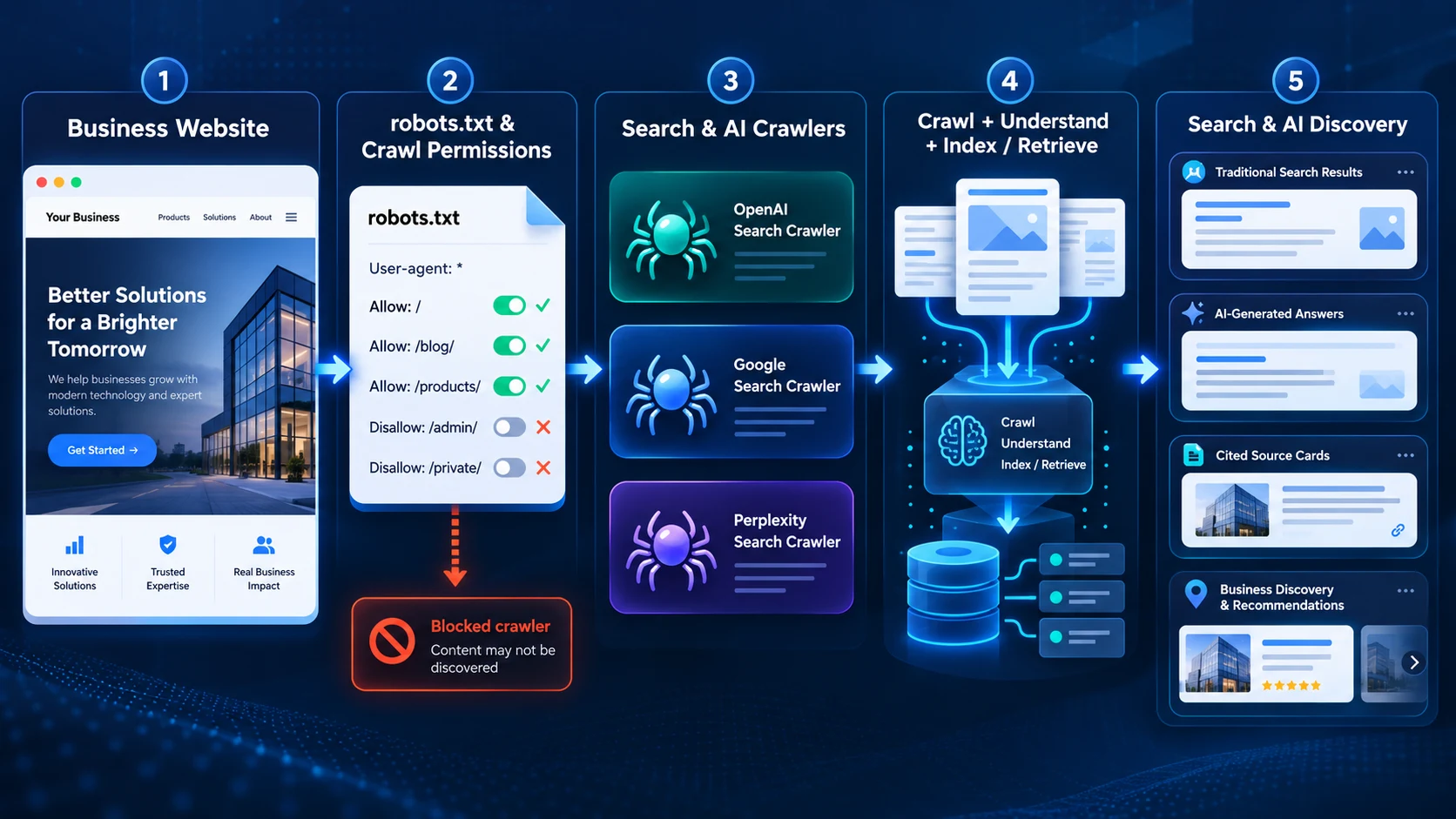
Nothing else matters if important content cannot be crawled.
A beautifully written service page hidden behind incorrect crawler rules, authentication, firewall restrictions or accidental noindex directives may never get a fair opportunity to appear.
ChatGPT and OAI-SearchBot
OpenAI uses OAI-SearchBot for search-related discovery.
According to OpenAI publisher guidance, sites that want their content to be eligible for inclusion in ChatGPT summaries and snippets should make sure OAI-SearchBot is not blocked.
A simple robots.txt configuration may look like:
User-agent: OAI-SearchBot
Allow: /
This does not guarantee that your pages will be cited.
It simply removes one possible technical barrier.
In its official bot documentation, OpenAI clearly distinguishes OAI-SearchBot from GPTBot. GPTBot relates to potential model-training crawls, while OAI-SearchBot is specifically dedicated to search discovery and real-time retrieval.
That distinction matters because businesses sometimes block every AI-related bot without understanding what each crawler does.
Perplexity and PerplexityBot
According to Perplexity crawler documentation, site owners should allow PerplexityBot when they want their website to be surfaced and linked through Perplexity search.
A basic directive may look like:
User-agent: PerplexityBot
Allow: /
In its crawler documentation, Perplexity also publishes verified crawler IP ranges and notes that Web Application Firewalls may need appropriate configuration so legitimate crawler traffic is not blocked.
Google AI Mode and AI Overviews
Google does not require a separate AI crawler configuration for appearing in AI Overviews or AI Mode.
A supporting web page needs to be indexed and eligible to appear in normal Google Search with a snippet. In Google's AI search documentation, Google explains that foundational search eligibility powers these features without requiring separate technical setups.
For a business website, technical checks should therefore include crawl permissions, HTTP response codes, canonical URLs, XML sitemaps, indexability, internal links and firewall/CDN behaviour.
2. Clearly State What Your Business Is, What It Does and Where It Operates
One of the simplest improvements a business can make is also one of the most overlooked:
Stop making search systems guess what your company does.
Consider this homepage description:
“We transform ideas into extraordinary digital experiences.”
It may sound attractive, but it gives very little factual information.
Compare it with:
“Webtrix Innovations is a web development and digital growth company providing web development, e-commerce, app development, SEO, Local SEO and related digital services for businesses in Vasai, Virar, Mumbai, the Mumbai Metropolitan Region and beyond.”
The second description establishes clear entities and relationships:
Company: Webtrix Innovations
Category: Web development and digital growth company
Services: Web development, e-commerce, apps, SEO and Local SEO
Audience: Businesses
Geographic context: Vasai, Virar, Mumbai and MMR
This type of factual clarity is useful for users, traditional search engines and AI systems.
Your Home, About and major service pages should consistently answer four basic questions:
| Question | What the Website Should Clarify |
|---|---|
| Who are you? | Official business or brand name |
| What do you provide? | Specific products or services |
| Who do you serve? | Relevant audience or customer type |
| Where do you operate? | Physical location or genuine service areas |
Avoid changing your core description dramatically between your website, Google Business Profile, LinkedIn and business directories.
Different wording is natural.
Contradictory positioning is not.
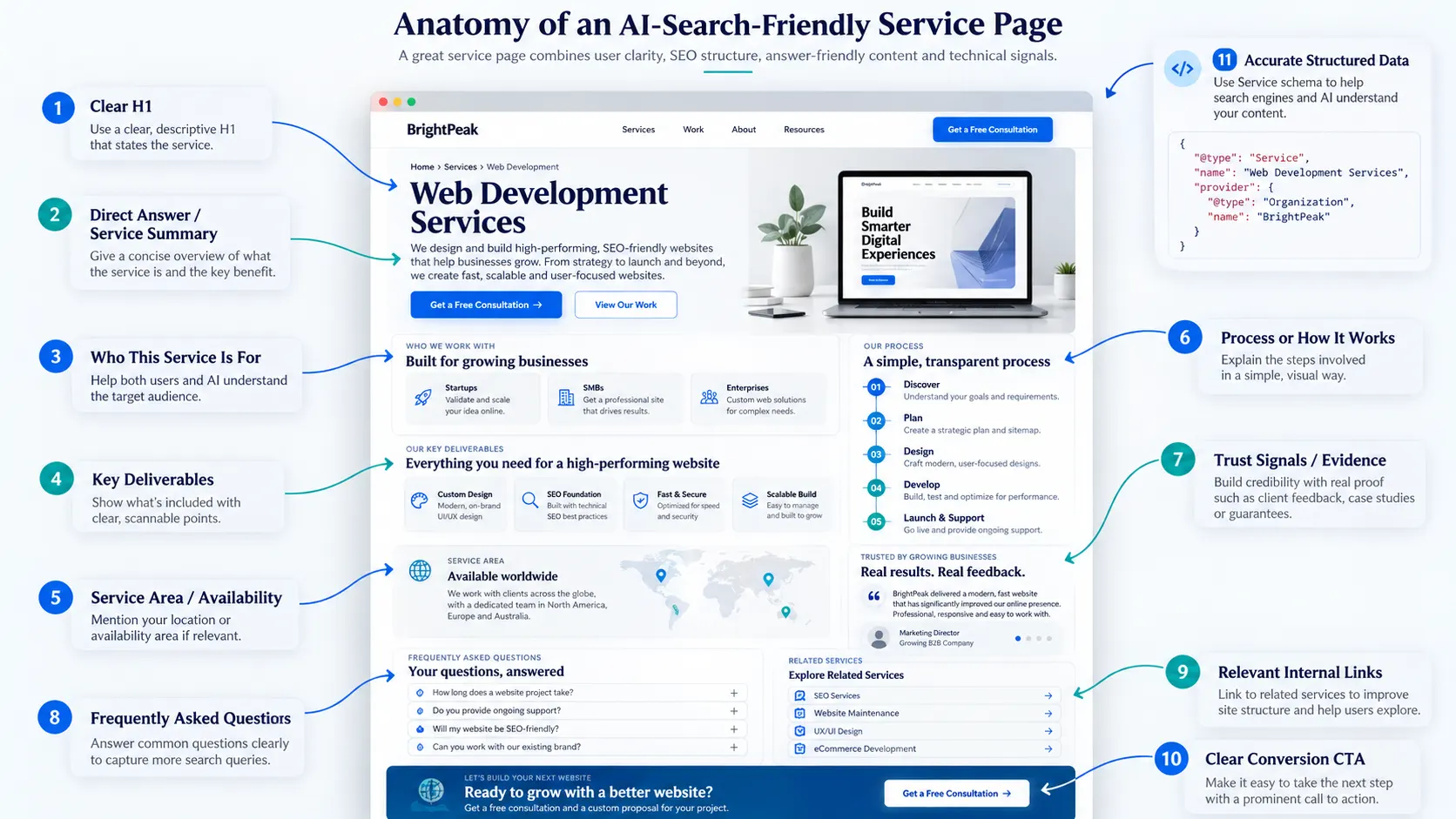
3. Build a Dedicated Page for Every Important Service
A single “Services” page that briefly mentions fifteen unrelated offerings gives search systems limited context about each individual service.
If a service is commercially important, it usually deserves a dedicated page.
For example, Webtrix Innovations separates services such as Web Development, SEO Optimization, Local SEO, E-Commerce Development, App Development and other digital services.
That structure helps establish clearer topical relationships than placing every offering inside a few homepage paragraphs.
A strong service page should explain what the service is, who it is suitable for, what problems it addresses, what the process looks like, relevant deliverables, geographic availability where appropriate, important limitations, related services and common customer questions.
This is useful for both traditional search and generative retrieval.
When a user asks:
“Can someone build a Laravel web application for my business?”
a detailed Web Development page provides much stronger context than a homepage that merely includes the words “web development.”
4. Answer Real Customer Questions Directly
AEO does not mean stuffing hundreds of FAQs onto every page.
It means making useful answers easy to locate.
For example:
How Long Does SEO Take to Show Results?
SEO does not have a universal guaranteed timeline. The time required depends on factors such as the website's existing condition, competition, technical issues, content quality, authority, target queries and market.
That answer gives the reader useful information immediately.
It is stronger than spending three paragraphs introducing SEO before eventually answering the question.
Use natural question-based headings where they genuinely improve the article.
Common commercial question patterns include:
What is...?
How does...?
How much does...?
How long does...?
Which option is suitable for...?
What is the difference between...?
Can a business...?
Why is...?
The answer should normally begin immediately after the heading.
Then expand with context.
This creates content that remains readable for humans while also making important passages easier for retrieval systems to interpret.
5. Publish Information That Adds Something New
AI search makes generic content less defensible.
If fifty websites publish essentially the same rewritten explanation, there is little reason for another nearly identical page to deserve attention.
Google Search Central's guidance on optimizing for generative AI emphasizes unique, valuable, non-commodity content rather than mechanically producing generic pages.
Businesses have several ways to create genuinely differentiated content.
A web development agency might publish real project observations, anonymized technical problems it repeatedly encounters, implementation screenshots, original checklists, comparison frameworks, testing methods, performance findings, pricing methodology or explanations based on actual development workflows.
A local service business might publish real service-area information, locally relevant examples, customer questions, eligibility rules, preparation instructions or original photos.
An e-commerce company might provide detailed product comparisons, sizing guidance, original images, practical use cases and genuine support information.
Originality does not mean inventing a brand-new idea.
It means contributing useful information beyond what could be produced by simply summarizing the first five search results.
6. Use Structured Data Correctly — But Do Not Treat It as an AI Ranking Hack
Structured data helps search engines understand explicit information about a page and its entities.
As outlined in Google structured data documentation, structured markup should accurately represent visible page content, with JSON-LD recommended as the standard implementation format.
For a business and blog website, appropriate schema may include types such as:
Organization
Service
BlogPosting
BreadcrumbList
and other schema that accurately represents the visible content.
For editorial content, Google's Article structured data documentation outlines support for schemas such as Article and BlogPosting, which can provide clearer information about elements such as the headline, author, images and publication dates.
However, an important myth needs to be removed:
There is no special “AI schema” required to appear in Google AI Mode or AI Overviews.
Google explicitly states that websites do not need special schema.org markup, special AI files or additional machine-readable files solely for inclusion in its generative AI Search features.
Structured data remains useful.
It simply should not be marketed as a guaranteed AI recommendation shortcut.
7. Do You Need an llms.txt File?
llms.txt has become one of the most discussed AI-search recommendations.
It may be useful in certain ecosystems or workflows, and some technology providers publish such files themselves.
However, website owners should distinguish between an optional emerging convention and an official ranking requirement.
Google's current guidance explicitly says that websites do not need to create unnecessary AI text files such as llms.txt to succeed in Google's generative Search experiences.
OpenAI's publisher guidance focuses on public accessibility and OAI-SearchBot rather than requiring an llms.txt file for ChatGPT Search eligibility.
Therefore:
An llms.txt file should not be your first AI-search priority.
Fix crawlability, content quality, site structure, business clarity and authority before spending significant time on speculative optimizations.
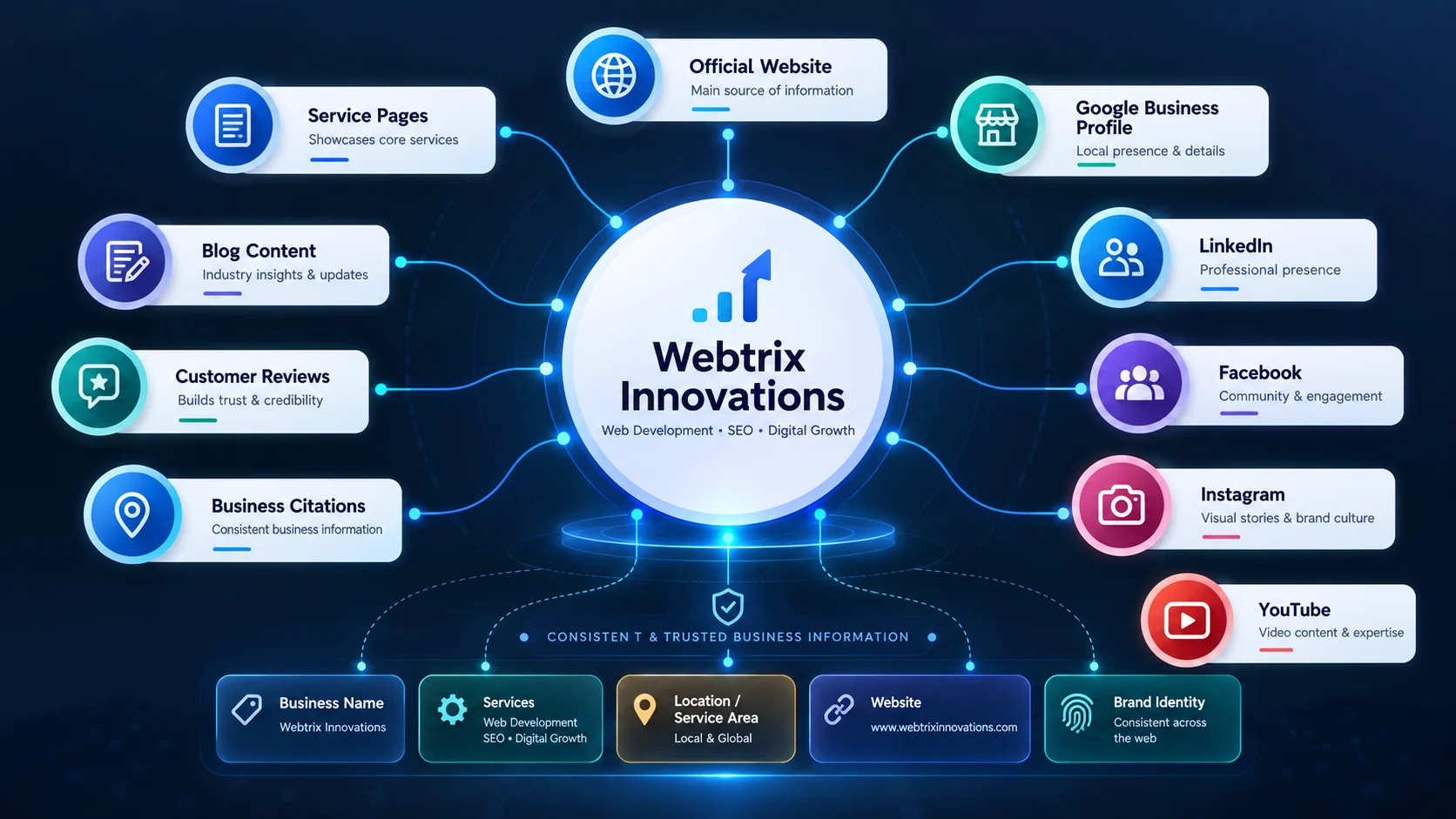
8. Strengthen Your Business Entity Across the Web
Your own website explains who you are.
The wider web can provide additional context.
For a legitimate business, consistent information across established profiles, directories, professional platforms and review sources can reduce ambiguity around the company.
That does not mean creating hundreds of spam directory profiles.
It means making important public business information accurate wherever your business genuinely maintains a presence.
For a local Indian business, this may include platforms such as its Google Business Profile, relevant industry directories, professional networks and legitimate social profiles.
The principle is straightforward:
If your website describes you as a web development company in Mumbai but every external profile contains outdated branding, a different phone number and different service information, the public web contains inconsistent evidence.
Consistency is especially important for business name, business category, services, website address, contact information and genuine geographic context.
9. Keep Google Business Profile Information Accurate
For businesses serving local customers, Google Business Profile remains important.
Google's AI-search guidance specifically recommends keeping Business Profile information up to date where relevant.
A business should make sure its profile accurately reflects its real business information, categories, contact details, service model and customer-facing information.
For service-area businesses, follow Google's eligibility and address-display requirements rather than adding fake locations purely to target additional cities.
Your website and Business Profile should support the same underlying business reality.
For more detail on local visibility problems, Webtrix Innovations has also published a guide covering why businesses may not appear on Google Maps and how to diagnose common visibility issues.
10. Build Internal Links Around Topics, Not Random Keywords
Internal linking is one of the simplest ways to help users and crawlers understand how pages relate.
Suppose your website publishes this AI-search guide.
Natural internal relationships could connect it with:
because technical SEO and content structure form the foundation.
because business identity, Business Profile information and regional visibility are relevant for local companies.
because technical architecture, semantic HTML, performance and crawlability often require development work.
because local business discovery overlaps with entity consistency and location relevance.
because businesses reading this article may want to check whether their own website has crawl, SEO or technical issues.
A useful content cluster helps search systems understand which pages are broad commercial pages and which pages provide supporting educational depth.
Avoid adding internal links merely because two pages contain the same keyword.
Link when the destination genuinely helps the reader continue their journey.
11. Make Important Information Available as Real Text
Important business information should not exist only inside promotional graphics, videos or images.
Google recommends making important content available in textual form, even when the page also uses high-quality images and videos.
For example, do not publish your entire service comparison as an image.
Write the information in HTML and use the image as supporting visual content.
The same applies to pricing, service coverage, feature comparisons, eligibility rules, process information and FAQs.
This also improves accessibility.
Modern AI agents can increasingly use different representations of a webpage, but clear semantic HTML remains one of the most dependable ways to communicate important information.
12. Improve Website Architecture and Accessibility
Search visibility and AI visibility are not purely content-writing problems.
A modern business website should have logical navigation, semantic heading structure, descriptive buttons and links, accessible labels, readable text, mobile-friendly layouts and reliable page rendering.
OpenAI notes that accessible markup such as appropriate ARIA labels and roles can help its browser-based agent understand interactive website components.
This becomes increasingly relevant as AI systems evolve beyond simply retrieving text and begin interacting with websites on behalf of users.
A future customer may not only ask:
“Which company provides this service?”
They may eventually ask an agent to compare providers, inspect packages, fill a form or perform another website interaction.
Building a clean, accessible website therefore supports users today while also creating stronger foundations for emerging agentic experiences.
13. Build Reputation Naturally — Do Not Manufacture AI Mentions
Businesses understandably want third-party mentions because independent sources can provide additional context about a brand.
But this is also where GEO strategies can become spammy.
Publishing dozens of fake “Top 10 Companies” articles, purchasing artificial reviews or creating fabricated Reddit discussions does not create a trustworthy brand.
Instead, pursue genuine visibility.
That might mean earning real customer reviews, contributing expert commentary, publishing useful research, participating appropriately in professional communities, developing partnerships or earning references from relevant industry websites.
Treat reputation building as normal business credibility work.
Not as a way to manipulate an AI model.
No credible provider can guarantee that a certain number of backlinks, mentions or reviews will force an AI assistant to recommend a business.
14. Use Clear Evidence When Making Claims
AI-friendly content should also be fact-friendly content.
Avoid statements such as:
“We are the #1 web development agency in Mumbai.”
unless you possess credible evidence supporting a clearly defined ranking methodology.
Likewise, avoid:
“We guarantee first-page Google rankings.”
or:
“Our GEO strategy guarantees ChatGPT recommendations.”
Claims like these are difficult to substantiate and create unnecessary trust problems.
Stronger copy would say:
“We provide web development services for businesses across Mumbai and surrounding areas.”
or:
“Our SEO work focuses on improving technical foundations, search relevance and organic visibility.”
The second type of language is specific, useful and defensible.
AI systems are only one reason to improve factual clarity.
Your customers also deserve accurate information.
15. Create Content Around the Entire Customer Decision
Keyword targeting remains useful.
But modern search requires broader intent understanding.
Consider somebody planning a new business website.
Their journey may include questions such as:
“What type of website do I need?”
“How much does website development cost in India?”
“Laravel vs WordPress—which is suitable?”
“How long will development take?”
“What should be included in a website quotation?”
“Do I need SEO with website development?”
“How do I choose a web development company in Mumbai?”
Each question represents part of the same underlying customer journey.
A company that provides clear, accurate resources throughout that journey builds far stronger topical coverage than a company publishing twenty variations of:
“Best web development company in Mumbai.”
This also aligns well with Google's query fan-out approach, where a complex AI-search question can lead to multiple related information requests.
16. Optimize for Local and Indian Search Context Where It Is Genuine
Indian businesses should not simply copy an American content strategy and replace “dollars” with “rupees.”
Local customer questions can differ.
Useful information might include genuine Indian pricing context, GST implications where relevant, Indian payment gateways, WhatsApp communication, local service areas, multilingual considerations, Google Business Profile behaviour, region-specific logistics and common Indian business workflows.
If someone asks:
“What does a business website cost in Mumbai?”
a page containing realistic Indian project context may satisfy the question better than a generic global pricing article.
Local relevance should come from useful information.
Not from repeatedly inserting city names into every paragraph.
For example:
“SEO company Mumbai Mumbai SEO services best SEO Mumbai agency Mumbai.”
does not make a page locally authoritative.
Useful local context does.
17. How to Track Traffic From ChatGPT
One major improvement in 2026 is that AI-search visibility is becoming more measurable.
According to OpenAI's publisher guidance on referral tracking, ChatGPT search automatically appends the parameter:
utm_source=chatgpt.comto referral URLs from ChatGPT search results, allowing website owners to analyze relevant referral traffic in analytics tools such as Google Analytics 4.
A business can therefore examine whether ChatGPT is sending visitors and then evaluate what those visitors actually do.
Traffic alone should not be the final objective.
Measure meaningful actions such as enquiries, calls, WhatsApp conversations, bookings, purchases, lead-form submissions and other business conversions.
18. How to Measure Google AI Mode and AI Overview Visibility
Google significantly improved AI-search measurement in 2026. As documented in Google Search Console documentation, dedicated performance reports allow site owners to monitor queries, impressions and clicks across search experiences including AI Overviews and AI Mode.
Google announced that, as of August 31, 2026, these reporting insights were rolled out to websites worldwide.
The reporting can provide information such as:
| Metric / Dimension | What It Helps You Understand |
|---|---|
| Impressions | How often site URLs appeared in generative AI features |
| Pages | Which URLs appeared |
| Countries | Geographic distribution of visibility |
| Devices | Device-level information where available |
| Dates | Changes in visibility over time |
This is considerably more useful than relying entirely on manually asking the same AI prompt repeatedly.
Manual testing can still be useful for qualitative research.
But first-party Search Console data should be a central part of measuring Google AI-search visibility.
19. Do Not Measure GEO With One Prompt
Suppose you ask ChatGPT:
“Best web development company in Mumbai?”
and your business is not mentioned.
That does not prove your entire GEO strategy has failed.
AI responses can depend on query wording, user context, available sources, freshness and the exact information being requested.
A better measurement framework uses a stable collection of real customer questions across different stages of the buying journey.
For example, a digital agency might monitor questions around service discovery, pricing, technology, location, project suitability and comparisons.
Then track whether the company appears, whether the description is accurate, which page is cited and whether visitors eventually reach the website.
The goal is useful visibility across relevant questions.
Not winning a single vanity prompt.
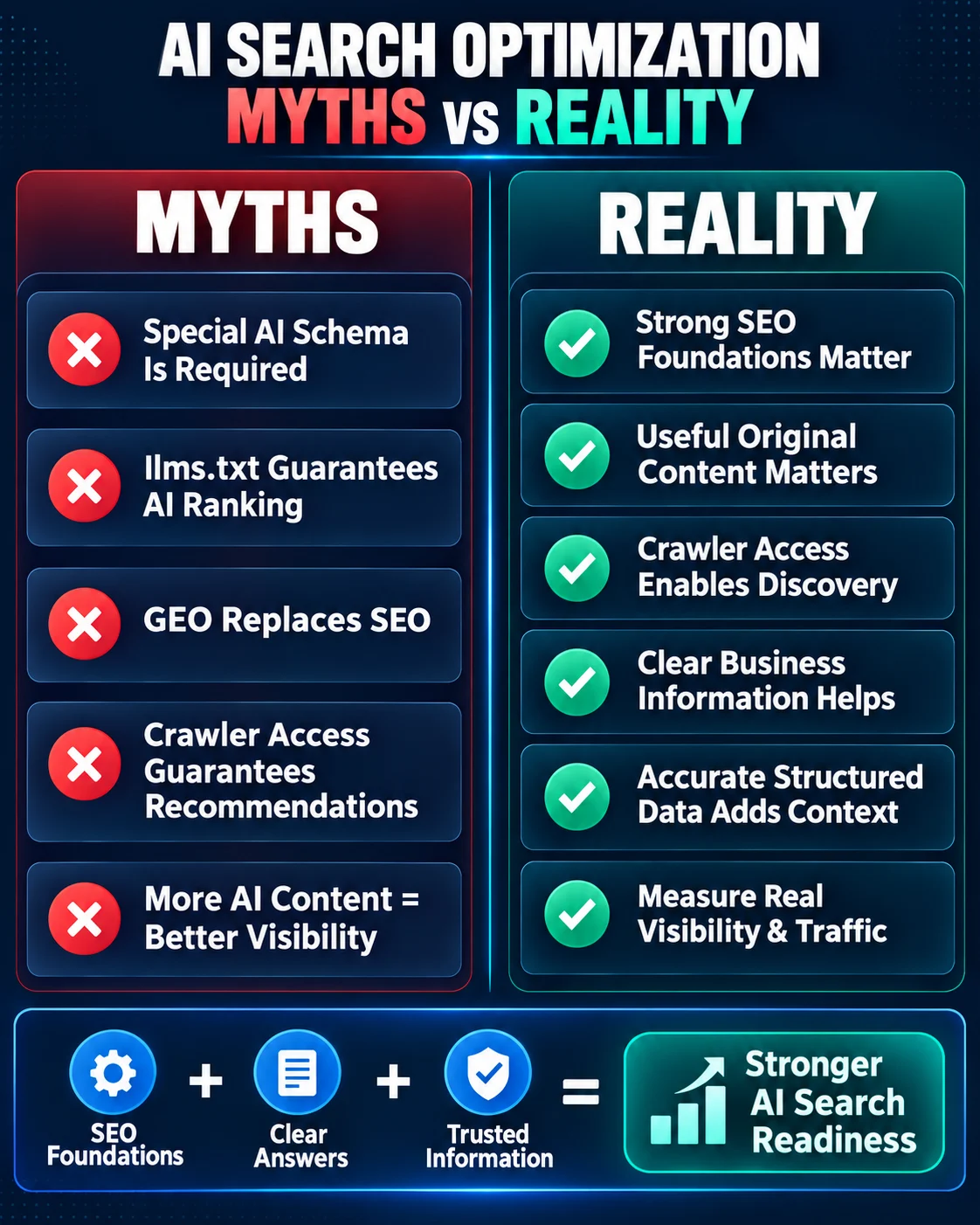
20. Common AI Search Optimization Myths in 2026
| Myth | Reality |
|---|---|
| “I need a special AI schema to appear in Google AI Mode.” | Google says no special schema is required for AI Mode or AI Overviews. |
| “Adding llms.txt will make my site rank in AI.” | It is not an official Google AI-search requirement, and OpenAI does not state that it guarantees ChatGPT visibility. |
| “OAI-SearchBot access guarantees a ChatGPT recommendation.” | It improves crawl eligibility; it does not guarantee citation or recommendation. |
| “GEO replaces SEO.” | Google says traditional SEO foundations remain relevant to generative Search. |
| “More AI-generated articles automatically create more AI visibility.” | Commodity content provides little differentiation; unique, useful content remains important. |
| “Schema automatically makes AI trust my company.” | Structured data provides explicit context but must accurately match visible content. |
| “I need hundreds of directory listings.” | Quality, relevance and factual consistency are more defensible than mass directory spam. |
| “One ChatGPT test tells me whether my optimization worked.” | AI responses are contextual; use broader, repeated measurement plus analytics data. |
| “Repeating my city everywhere improves local AI visibility.” | Genuine geographic context and accurate business information are more useful than location keyword stuffing. |
| “Someone can guarantee that ChatGPT will recommend my company.” | Inclusion and recommendations are controlled by the respective platforms; no legitimate optimization can guarantee a specific answer. |
What We Check During an AI Search Readiness Audit
At Webtrix Innovations, an AI-search readiness review starts with the same fundamentals that support strong organic search visibility. We check whether important pages are crawlable and indexable, review canonical URLs and robots directives, verify business and service information, inspect structured data, evaluate internal linking, review dedicated service-page coverage and confirm that analytics and conversion tracking are configured correctly.
We also review whether important customer questions are answered clearly and whether the website gives search and AI systems enough reliable context to understand the business, its services and its operating areas.
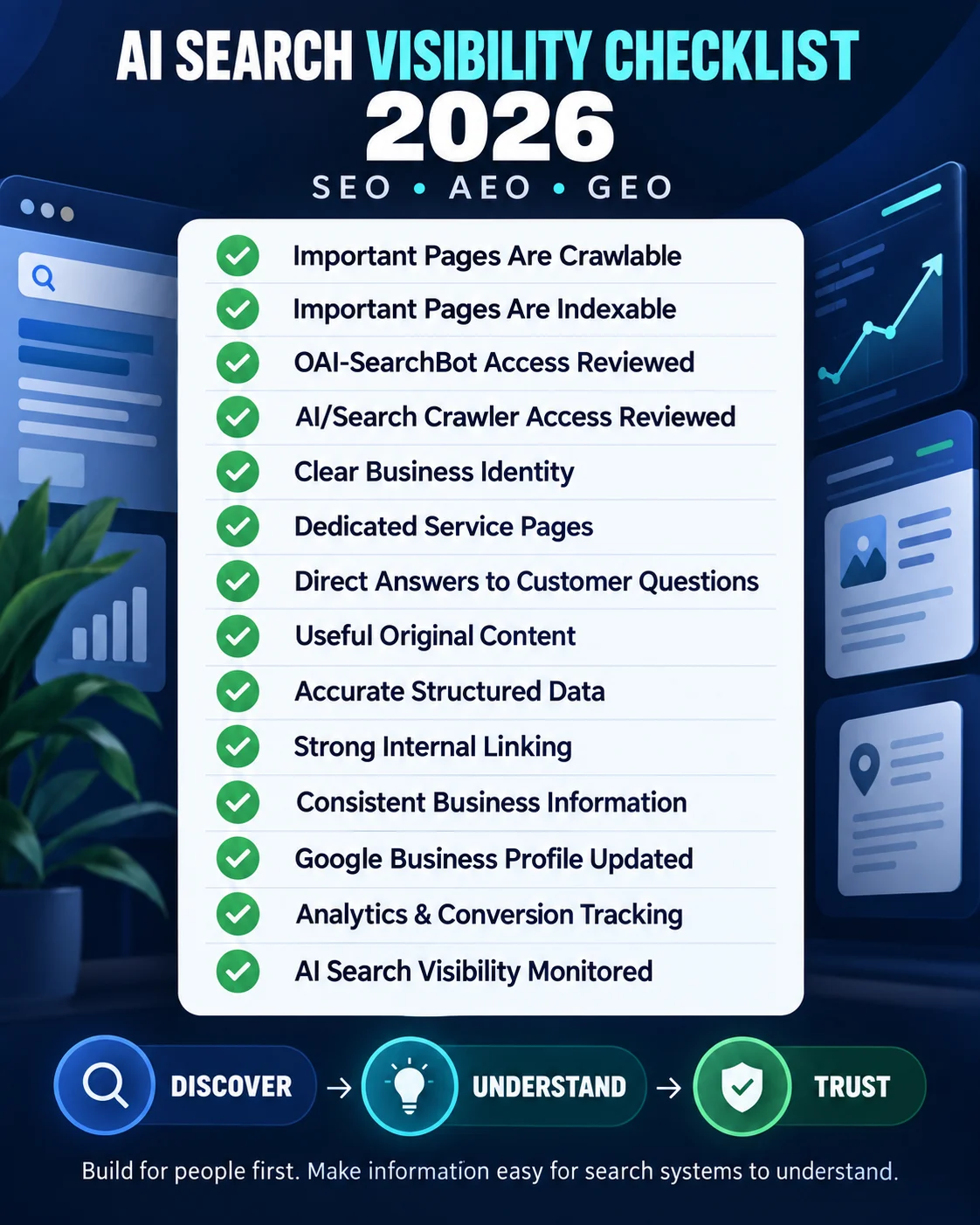
A Practical AI Search Visibility Checklist
| Area | Check |
|---|---|
| Crawl Access | Important pages are accessible to normal search crawlers |
| ChatGPT Access | OAI-SearchBot is not unintentionally blocked |
| Perplexity Access | PerplexityBot access has been reviewed |
| Firewall | CDN/WAF rules are not accidentally returning crawler-blocking responses |
| Indexing | Important Google pages are indexable and eligible for snippets |
| Canonicals | Canonical tags point to the intended URLs |
| Sitemap | Canonical indexable pages are included in the XML sitemap |
| Business Identity | Company name, services and operating area are clearly stated |
| Service Architecture | Important services have dedicated pages |
| Answer Content | Customer questions receive clear, direct answers |
| Unique Value | Content contains useful information beyond generic summaries |
| Structured Data | Relevant schema matches visible factual content |
| Internal Links | Supporting guides connect logically with service pages |
| Local Information | Google Business Profile and public business information are accurate |
| Measurement | Search Console, analytics and conversion tracking are configured |
You do not need to complete every possible AI-search tactic before your business can appear.
Start with strong technical and informational foundations.
What Should Small Businesses Do First?
For most small businesses, the priority order is straightforward.
First, make sure the website can actually be crawled and indexed.
Second, clearly explain what the business offers and where it operates.
Third, build high-quality pages around important services.
Fourth, answer real customer questions through useful supporting content.
Fifth, keep business information accurate across important public platforms.
Then improve structured data, internal linking, reputation and measurement over time.
This process is less exciting than a “secret ChatGPT ranking hack.”
But it creates a more durable digital presence across Google Search, AI-powered search and future discovery experiences.
Can a Local Business Appear in ChatGPT or AI Search?
Yes.
OpenAI states that public websites can appear in ChatGPT Search, provided relevant discovery conditions are met.
A small local business does not need to become a nationally famous brand before its website can become useful to an AI-powered answer.
For example, a user may ask:
“Who provides website development services in Vasai?”
That is a much narrower information need than:
“What are the world's best web development companies?”
A local business can improve its chances of being understood for relevant local questions by clearly establishing its genuine location or service area, services, business identity, useful local content and credible wider-web information.
Again, visibility is not guaranteed.
The objective is to provide enough clear evidence for search systems to accurately understand when the business may be relevant.
Is Traditional SEO Still Worth Doing in the AI Era?
Yes.
Google's official position is particularly clear on this.
Its generative Search systems continue to build on Google's core Search infrastructure and ranking systems. Foundational SEO practices remain relevant for AI Overviews and AI Mode.
That means businesses should not abandon:
technical SEO,
useful content,
internal linking,
website architecture,
page experience,
structured data,
crawlability,
search intent,
local optimization,
and authority development
just because AI search is growing.
The interface is changing.
The need for useful and trustworthy information is not.
Frequently Asked Questions
How Do I Get My Business Recommended by ChatGPT?
There is no guaranteed submission process for getting a business recommended by ChatGPT. Make your public website accessible to OAI-SearchBot, clearly describe your services and business identity, publish useful content and maintain accurate information across the wider web. In its crawlers documentation, OpenAI confirms that public websites can appear in ChatGPT Search but does not guarantee inclusion in individual answers.
What Is ChatGPT SEO?
ChatGPT SEO is an informal term for improving a website's ability to be discovered, understood and potentially referenced through ChatGPT's search experiences. It overlaps heavily with traditional technical SEO, content quality, entity clarity and broader AI-search optimization.
What Is GEO?
GEO stands for Generative Engine Optimization. It generally describes work intended to improve a brand or website's visibility in generative AI search and answer experiences. GEO should complement strong SEO foundations rather than replace them.
What Is AEO?
AEO stands for Answer Engine Optimization. It focuses on making information clear and easy to use in direct-answer environments through well-structured questions, concise answers and unambiguous factual content.
Does ChatGPT Crawl Websites?
OpenAI operates OAI-SearchBot for search discovery. OpenAI recommends allowing the crawler if publishers want their content to be discoverable and included in relevant ChatGPT search summaries and snippets.
What Is the Difference Between OAI-SearchBot and GPTBot?
According to OpenAI documentation, OAI-SearchBot is relevant to search discovery, while GPTBot relates to content that may be used for model training. Website owners can manage these user agents separately through crawler controls.
Does Perplexity Crawl Websites?
Yes. In its crawler documentation, Perplexity documents a crawler called PerplexityBot, designed to surface and link websites in Perplexity search results. Perplexity recommends allowing this bot when website owners want their content available for search discovery.
Do I Need Special Schema for Google AI Mode?
No. In Google Search Central documentation, Google states that there is no special schema.org structured data required specifically for AI Overviews or AI Mode. Existing structured data remains useful when it accurately describes visible content.
Do I Need llms.txt for AI SEO?
Not as a requirement. In its guidance for webmasters, Google specifies that unnecessary AI text files such as llms.txt are not required for its generative AI Search experiences. OpenAI's publisher guidance also does not make llms.txt a requirement for ChatGPT Search.
Can Structured Data Improve AI Visibility?
Structured data can help search systems understand explicit facts and relationships on a webpage, but it should not be treated as a guaranteed AI-ranking mechanism. It must accurately reflect visible page content.
Can I Track Visitors Coming From ChatGPT?
Yes. As outlined in OpenAI publisher documentation, ChatGPT search referral URLs automatically include utm_source=chatgpt.com, which can help website owners identify relevant traffic in analytics platforms such as Google Analytics.
Can I Measure Google AI Overview or AI Mode Visibility?
Yes. In Search Console Help documentation, Google outlines dedicated Generative AI performance reporting. As of August 31, 2026, Google announced the insights had been rolled out to websites worldwide.
Does AI Search Replace Google SEO?
No. In Google's official AI Search overview, Google explains that foundational SEO practices remain essential because its generative AI features are built on core Search ranking infrastructure. AI search changes how information may be presented, but crawlability, relevance, useful content and technical foundations remain important.
Can Any Agency Guarantee ChatGPT Rankings or Recommendations?
No business can responsibly guarantee that a third-party AI platform will produce a particular recommendation. Search and AI platforms ultimately control crawling, retrieval and answer generation. Optimization can improve your website's accessibility, clarity and relevance, but it cannot guarantee a particular output.
Official Platform Documentation & References
For technical verification and direct platform specifications, refer to the following official resources:
- OpenAI Platform Bots Documentation: Overview of OAI-SearchBot and GPTBot Web Crawlers
- OpenAI Publisher & Referral FAQ: Publishers and Developers FAQ & ChatGPT Referral URL Structure
- Google Search Central (AI Search Features): AI Features in Google Search & Eligibility Guidelines
- Google Search Central (Content Guidance): Creating Helpful, Reliable, People-First Content in Search
- Google Search Central (Structured Data): Introduction to Structured Data Markup
- Google Search Central (Article Schema): Article and BlogPosting Schema Specifications
- Google Search Console (Performance Reports): Performance Report Guidance for Search & Generative AI Appearances
- Perplexity AI (Crawler Documentation): PerplexityBot Crawler Overview & IP Allowlist Verification
Final Takeaway
AI search is changing how customers discover businesses, but the fundamentals are less mysterious than much of the marketing around GEO suggests.
Make your website accessible.
Clearly explain who you are.
Build strong pages for important services.
Answer real customer questions.
Publish original and useful information.
Use structured data accurately.
Keep public business information consistent.
Earn genuine authority.
Measure real visibility and conversions.
The businesses that adapt successfully will not necessarily be the ones producing the most AI-generated content or installing every new experimental file.
They will be the businesses that make accurate, useful information easy for both people and search systems to find, understand and trust.
If your website is difficult to crawl, unclear about its services, missing important search foundations or not structured for modern discovery, start with the fundamentals.
Need help implementing this in your business?
Explore our professional development and design capabilities.
About Webtrix Innovations
Webtrix Innovations designs and develops modern websites, web applications, e-commerce stores, and digital marketing strategies for growing businesses.