How to Sell Your Products Online in India: Shopify vs Custom Store Guide (2026)
Learn how to sell products online in India in 2026. Complete guide on is Shopify available in India, UPI payment gateways, shipping, and Shopify vs Custom stores.

Every ambitious manufacturer, retail business owner, and direct-to-consumer (D2C) founder in India eventually reaches the same critical turning point.
You have developed high-quality products. Your offline customers, local distributors, or Instagram followers love what you offer.
Now, you want to scale nationwide.
You ask the question that hundreds of Indian entrepreneurs type into Google every single day: “How to sell my product online in India?”
And almost immediately, another specific question follows: “Is Shopify available in India, and is it the best platform for my business?”
The short answer is yes—Shopify is active in India. But building a genuinely profitable e-commerce business in the Indian market involves unique operational realities that foreign software tutorials never talk about.
In India, over 70% of digital transactions happen via UPI (Google Pay, PhonePe, Paytm). Up to 50% of orders demand Cash-on-Delivery (COD), leading to painful Return-to-Origin (RTO) courier losses if unverified. In addition, mandatory GST e-invoicing, regional courier integration across 29,000+ PIN codes, and mobile checkout speeds on cellular 4G/5G connections make or break your profit margins.
This comprehensive, practical guide breaks down the complete 6-step blueprint on how to sell products online in India in 2026, provides a transparent reality check on Shopify’s Indian pricing and hidden fees, and compares Shopify head-to-head against a custom-engineered e-commerce store (Laravel/Vue) so you can make the right platform decision from Day 1.
To understand how to sell my product online in India in 2026: you need a registered business entity (Proprietorship, LLP, or Pvt Ltd), an active GSTIN (mandatory for inter-state e-commerce), a dedicated online storefront, an Indian payment gateway supporting seamless UPI Intent (Razorpay, Cashfree, or PhonePe PG), and automated courier shipping (Shiprocket or Delhivery) combined with automated WhatsApp COD order confirmation. Is Shopify available in India? Yes, Shopify is fully accessible in India with plans starting at ₹1,999/month. However, because native Shopify Payments is not supported in India, merchants must connect third-party payment gateways and pay Shopify an extra 0.5%–2.0% transaction commission on every sale, alongside recurring monthly app fees for GST invoicing, pincode checkers, and WhatsApp automation. High-growth brands doing over ₹3–5 Lakh/month often save ₹3 Lakh to ₹7 Lakh over three years by choosing a custom-engineered store (Laravel or Next.js) with 0% platform commissions and sub-second mobile speed.
Key Takeaways: Selling Online in India (2026 Summary)
- GST is Non-Negotiable: Under Section 24 of the CGST Act, e-commerce sellers shipping goods across state borders must hold a valid GSTIN regardless of annual turnover.
- Is Shopify in India? Yes, Shopify bills in Indian Rupees (INR) and integrates with Indian couriers, but charges a 0.5%–2% commission on third-party gateways because Shopify Payments is not live in India.
- UPI Dominates Checkout: Over 75% of Indian online prepaid payments are made through UPI. If your checkout redirects users through clunky popups, your cart abandonment rate will skyrocket.
- The COD RTO Challenge: Cash-on-Delivery accounts for 40%–60% of consumer orders. Deploying an automated WhatsApp confirmation workflow before dispatching orders reduces expensive RTO courier losses by over 65%.
- Shopify vs Custom: Shopify is great for fast testing (under 50 orders/month) with low upfront capital. A custom-engineered store delivers 0% ongoing platform rent, sub-second Google PageSpeed (95+), and complete customer database ownership.
Quick Answer: How to Sell Products Online in India
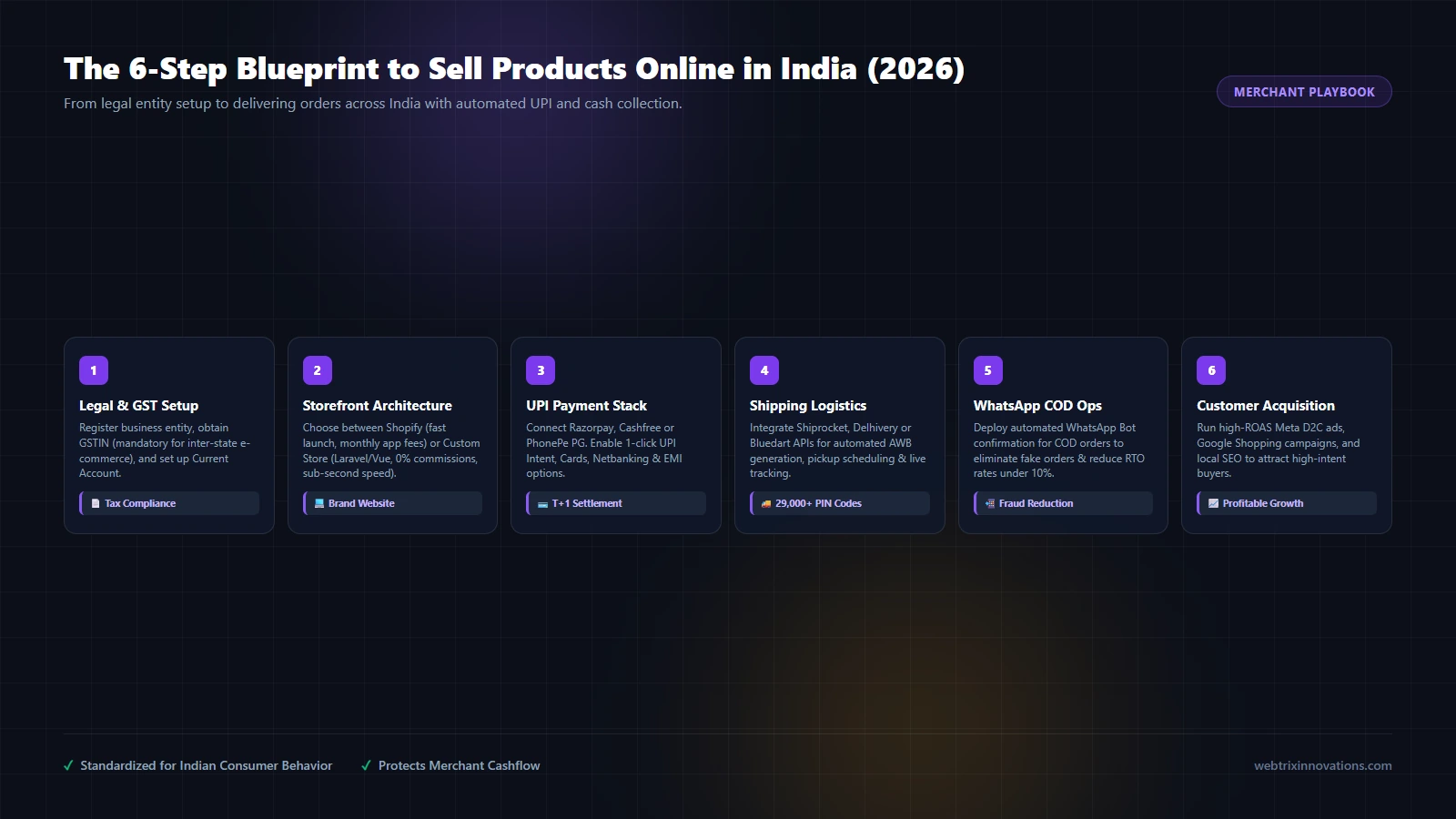
Launching a profitable online store in India requires executing a structured 6-stage lifecycle:
- Obtain Business & Tax Registration: Register your business entity and obtain your 15-digit GSTIN (mandatory for inter-state e-commerce supply).
- Select Your Storefront Platform: Choose between a SaaS platform like Shopify (quick setup, monthly app subscriptions) or a Custom Store built on Laravel or Next.js (complete IP ownership, 0% platform fees, sub-second speed).
- Integrate Indian Payment Stack: Onboard with RBI-authorized payment aggregators like Razorpay, Cashfree, or PhonePe PG to accept 1-click UPI Intent, Credit/Debit cards, Netbanking, and EMI.
- Connect Shipping & Logistics Aggregators: Link Shiprocket or Delhivery APIs to automate Airway Bill (AWB) generation, live tracking notifications, and doorstep pickup across 29,000+ PIN codes.
- Automate WhatsApp COD Verification: Deploy automated WhatsApp Cloud API messaging to verify customer addresses and confirm COD orders before warehouse dispatch.
- Drive Qualified Shoppers: Attract buying customers through localized SEO, Google Shopping product feeds, and targeted Meta/Instagram D2C advertising.
Step 1: Legal and Banking Prerequisites (GST, Business Entity & Current Account)
Before designing your store or uploading product photographs, you must establish the legal and financial foundation required by Indian regulatory authorities.
1. Business Entity Structure
- Sole Proprietorship: Easiest and fastest to register (using an Udyam Aadhaar or Shop & Establishment Act license). Best for solopreneurs testing their first product concept.
- Limited Liability Partnership (LLP) or Private Limited (Pvt Ltd): Strongly recommended for brands with co-founders, external angel investment, or those handling significant inventory. It provides personal asset liability protection.
2. GST Registration (The Mandatory Rule for Online Sellers)
In offline retail, businesses can operate without GST until their annual turnover reaches ₹40 Lakh (or ₹20 Lakh in some special states). However, under Section 24 of the Central Goods and Services Tax (CGST) Act, any person or company supplying goods through an e-commerce platform across state borders is mandatorily required to obtain GST registration, irrespective of turnover.
Payment gateways (like Razorpay and Cashfree) and courier partners (like Shiprocket and Delhivery) will not activate commercial accounts without a verified GSTIN.
3. Business Current Bank Account
Open a dedicated current account in your legal business name with a commercial bank (HDFC, ICICI, Kotak, Axis, or SBI). Payment gateways settle funds on a T+1 or T+2 cycle directly into this account.
Step 2: Amazon & Flipkart vs Your Own Independent D2C Store
When beginners consider how to sell their product online, they often think selling on Amazon or Flipkart is the only option.
While marketplaces provide instant search traffic, relying exclusively on Amazon or Flipkart creates severe business vulnerabilities:
| Operational Factor | Marketplaces (Amazon / Flipkart) | Independent D2C Store (Shopify / Custom) |
|---|---|---|
| Commissions per Sale | High: 15% – 35% commission + closing fee + pick-pack charges | Low: ~2% standard payment gateway fee only (0% platform rent on custom) |
| Customer Data Ownership | Zero: Customer phone numbers and emails are masked and hidden. | 100%: Complete customer database (phone, email, order history) for WhatsApp CRM & repeat sales. |
| Competitor Hijacking | Competitors buy sponsored ad banners right below your product listing. | Zero competitor ads: 100% focused on your brand identity and products. |
| Pricing Control | Relentless price-matching race to the bottom against copycat sellers. | Full premium brand positioning with bundles, subscriptions, and custom offers. |
The winning strategy for Indian brands in 2026 is Omnichannel D2C: use Amazon for product discovery, but build your primary brand headquarters on your own independent website where you retain 100% customer relationships and higher profit margins.
Step 3: Is Shopify Available in India? Complete Reality & Cost Check
One of the most frequently asked questions by Indian business owners is: Is Shopify available in India?
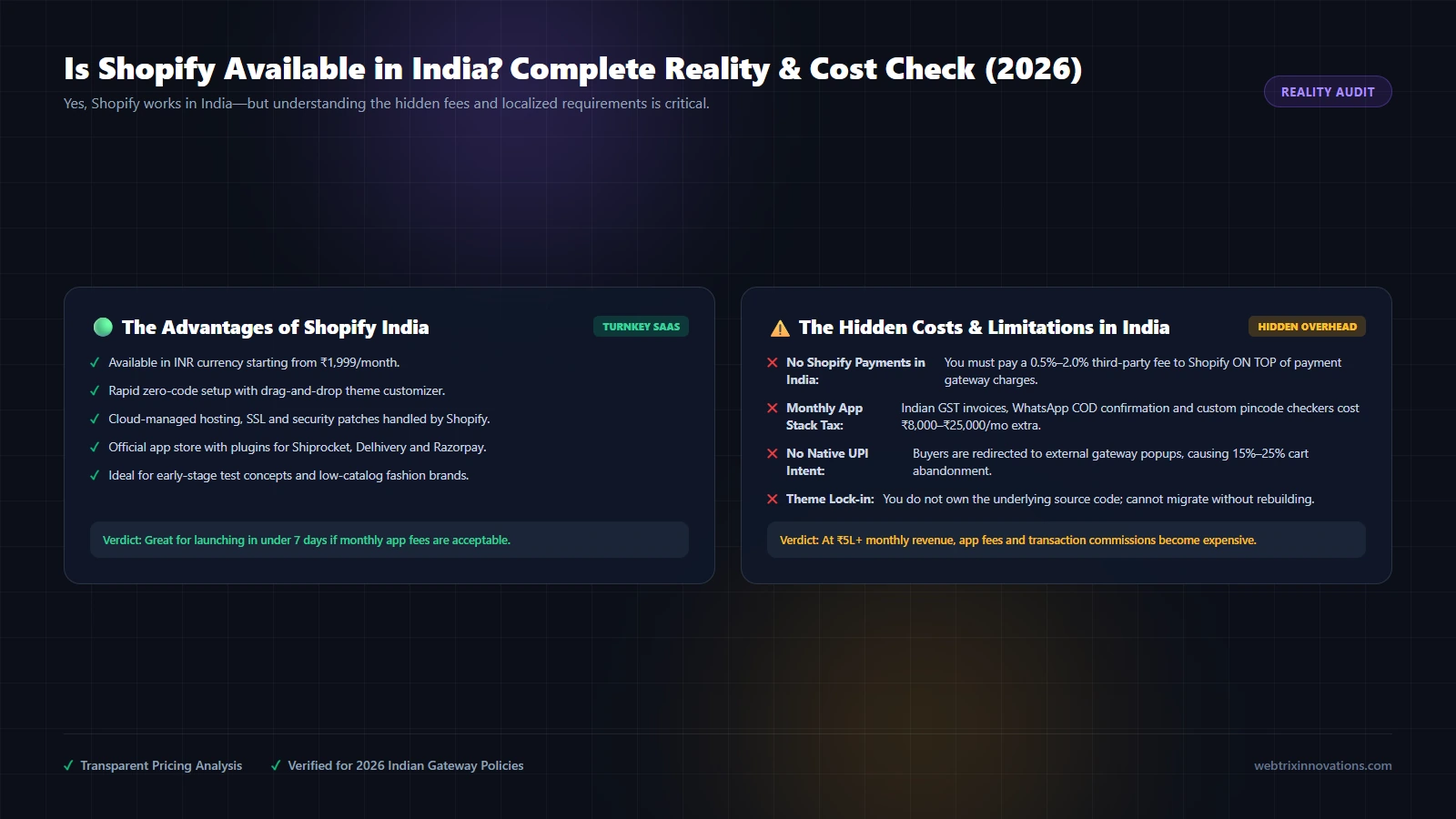
Yes, Shopify is fully available and operates officially in India. Indian merchants can sign up, create an online store, set Indian Rupees (INR) as the store currency, configure Indian GST tax rules, and integrate local payment gateways and couriers.
Shopify Official Pricing Plans in India (2026):
- Basic Plan: ₹1,999 / month + 18% GST (Includes standard store, basic analytics, 2 staff accounts).
- Shopify Plan: ₹7,499 / month + 18% GST (Lower transaction fee, 5 staff accounts, improved reporting).
- Advanced Plan: ₹30,160 / month + 18% GST (15 staff accounts, custom report builder).
The 4 Hidden Costs Every Indian Business Must Understand:
1. No Native "Shopify Payments" in India (The Transaction Penalty)
In the US, UK, and Australia, Shopify provides its own payment gateway (Shopify Payments) with zero transaction surcharge. In India, Shopify Payments is not available.
Because you must use a third-party Indian gateway (such as Razorpay or Cashfree), Shopify penalizes you by charging an extra 0.5% to 2.0% transaction commission on every single order on top of the ~2% fee charged by your payment gateway!
2. The "App Stack Tax" (₹8,000 to ₹25,000/Month)
Out of the box, Shopify does not include features essential for the Indian market. To run an Indian store, you must install paid third-party apps from the Shopify App Store:
- Indian GST Invoicing App: ₹800 – ₹2,500 / month
- Automated WhatsApp Order & COD Confirmation App: ₹1,500 – ₹6,000 / month
- Indian PIN Code Checker & Serviceability App: ₹500 – ₹1,500 / month
- Product Reviews & Photo Rating App: ₹1,200 – ₹4,000 / month
- Abandoned Cart Recovery via WhatsApp: ₹2,000 – ₹8,000 / month
What looks like a ₹1,999/month store quickly balloons into a ₹15,000 to ₹30,000 monthly operational bill before you even spend a single rupee on advertising.
3. Clunky Redirects on Mobile UPI Payments
Because Shopify does not support custom native checkout code on standard plans, shoppers checking out via UPI are often redirected to third-party web views or popup modals. This extra step causes friction, leading to a 15%–25% payment drop-off rate among Indian mobile shoppers.
4. Zero Code Ownership (Theme Lock-in)
You do not own the software. If you ever decide to leave Shopify, you cannot export your store design or custom features. You must rebuild your entire platform from scratch.
Step 4: The Custom E-Commerce Store Alternative (Laravel / Next.js)
For established businesses, manufacturers, high-volume retail stores, or scaling D2C brands, building a custom-engineered e-commerce platform (using modern frameworks like Laravel, Vue, React, or Next.js) provides massive operational and financial advantages.
Why Indian Brands Choose Custom E-Commerce:
- 0% Platform Commission: You only pay standard bank gateway charges (~2%). You never pay platform rent or per-transaction penalties to Shopify.
- Zero Monthly App Subscriptions: GST invoicing, automated WhatsApp notifications, PIN code checkers, and review systems are coded directly into the platform codebase. You save ₹1.5 Lakh to ₹3 Lakh every single year.
- Sub-Second Mobile Page Speed: Clean custom code without 20 heavy JavaScript app tracking tags achieves 95+ Google PageSpeed scores. In e-commerce, every 1-second reduction in page load speed boosts conversion rates by up to 27%.
- 1-Click Native UPI Intent: The checkout triggers the user's Google Pay, PhonePe, or Paytm app directly inside the smartphone with zero redirects or popup friction.
- 100% Intellectual Property Ownership: You own the complete source code, database architecture, and hosting server. Your business has an independent digital asset that adds equity valuation to your company.
Step 5: Setting Up Indian Payment Gateways (UPI, Razorpay, Cashfree & PhonePe)
In India, customer payment preferences differ radically from Western markets:
- UPI (Unified Payments Interface): Accounts for 70% to 80% of all prepaid e-commerce volume.
- Debit & Credit Cards: 15% to 20% (Mastercard, Visa, RuPay).
- Netbanking & EMI: 5% to 10% (Popular for high-ticket electronics, furniture, and B2B orders).
Top Payment Aggregators in India (2026):
- Razorpay: The industry standard in India. Excellent developer APIs, instant T+1 settlements, and built-in Magic Checkout for fast address pre-filling. Standard transaction fee: ~2% + 18% GST.
- Cashfree Payments: Outstanding for instant payment disbursals, high-volume UPI transactions, and automated customer refund processing.
- PhonePe Payment Gateway: Highly competitive pricing for UPI transactions with near-zero latency across the PhonePe ecosystem.
Step 6: Automated Shipping Logistics & Solving the COD RTO Nightmare
In Indian e-commerce, taking the order is easy. Delivering the package and collecting the payment is where most businesses struggle.
The RTO Nightmare Explained:
Between 40% and 60% of Indian online shoppers choose Cash-on-Delivery (COD). However, across India, 20% to 35% of unverified COD orders end up as Return-to-Origin (RTO)—the buyer changes their mind, enters a fake address, or refuses delivery at their door.
Every time an RTO occurs, the seller loses forward shipping costs (₹60–₹120) plus reverse shipping costs (₹60–₹120), destroying profit margins.
The Automated WhatsApp Verification Workflow (The Solution):
At Webtrix Innovations, we engineer an automated WhatsApp Cloud API workflow for our e-commerce clients:
- When a buyer places a COD order, the system automatically sends a WhatsApp verification prompt to their mobile number.
- The message features two one-tap interactive buttons: [Confirm Order] or [Cancel Order].
- If confirmed, the API pushes the order directly to Shiprocket or Delhivery, automatically generating the shipping label and AWB tracking code.
- If unconfirmed after 12 hours, the order is flagged for manual follow-up, preventing inventory lock-up and shipping losses.
This automated workflow reduces client RTO rates from 30% down to under 8%, saving Indian stores lakhs in courier penalties.
Head-to-Head Comparison: Shopify vs Custom Online Store (2026)
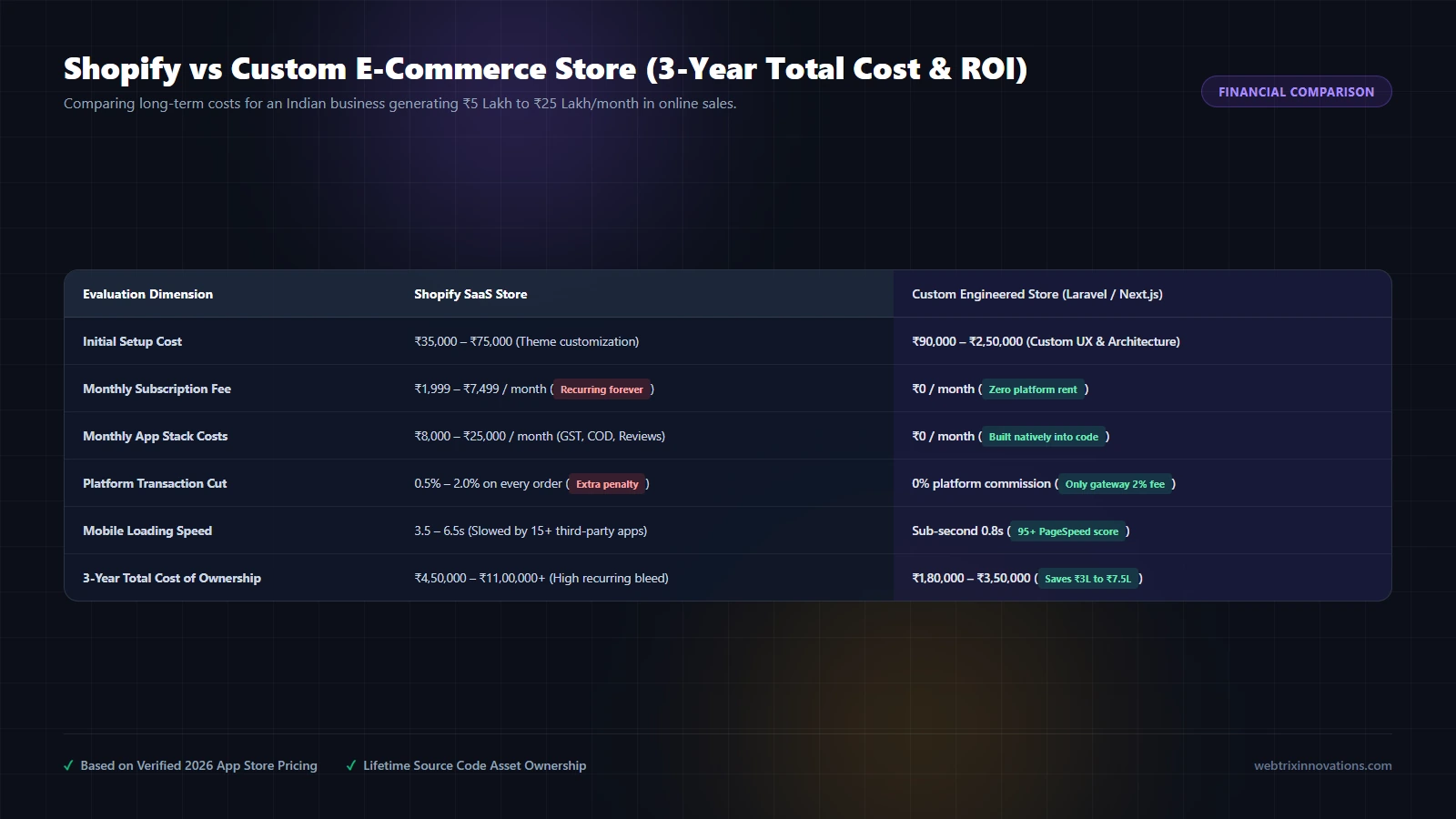
| Feature / Metric | Shopify SaaS Store | Custom Engineered Store (Webtrix Stack) |
|---|---|---|
| Time to Launch | Fast (5 to 14 days) | Moderate (3 to 6 weeks) |
| Upfront Development Cost | ₹25,000 – ₹65,000 (Theme customization) | ₹75,000 – ₹2,50,000 (Custom UX & Architecture) |
| Ongoing Platform Rent | ₹1,999 – ₹7,499 / month + GST (Perpetual) | ₹0 / month (Zero platform subscription) |
| Third-Party App Costs | ₹8,000 – ₹25,000 / month for Indian features | ₹0 / month (All features built natively into code) |
| Transaction Commission | 0.5% – 2.0% extra commission to Shopify | 0% platform commission (Only gateway fee ~2%) |
| Mobile PageSpeed & Core Web Vitals | Average (35–65 on mobile due to app scripts) | Sub-second (95–100 Google PageSpeed score) |
| Native UPI Intent Checkout | Requires redirect or external gateway popup | 1-click direct app opening (Google Pay / PhonePe) |
| Code & Database Ownership | Shopify owns infrastructure; locked into ecosystem | 100% Client IP ownership; host on your cloud VPS |
| 3-Year Total Cost of Ownership | ₹4,50,000 – ₹11,00,000+ | ₹1,80,000 – ₹3,50,000 (Saves ₹3L to ₹7.5L) |
| Recommended For | New businesses testing product-market fit (<50 orders/mo) | Established brands, scaling D2C, manufacturers & high volume |
Local Case Study: Mumbai MMR, Bhiwandi & Vasai Manufacturers Going D2C
Across the Mumbai Metropolitan Region—including the manufacturing corridors of Vasai, Virar, Palghar, Thane, and the massive logistics hubs of Bhiwandi—hundreds of traditional B2B manufacturers are transitioning to high-margin Direct-to-Consumer (D2C) online retail.
A regional home decor and apparel manufacturer based in Vasai previously relied on traditional wholesale distributors, capturing thin 12% operating margins. By collaborating with Webtrix Innovations at our registered office in Silver Arcade Building, Vasai West, we engineered a custom high-performance e-commerce storefront with integrated Razorpay UPI, Shiprocket automated dispatch, and GST-compliant invoicing.
Within six months of launch, their online store reached over 1,200 monthly retail orders shipped across India at a healthy 44% gross margin, freeing them completely from distributor payment delays and middleman commissions.
Google Shopping & AI Search Optimization (AEO in 2026)
In 2026, selling products online is no longer just about Google Search keyword rankings. Conversational AI search engines like Google Gemini, ChatGPT Search, and Perplexity actively recommend products when users ask natural language questions like:
“What is the most durable, highly rated ergonomic office chair manufactured in India under ₹15,000?”
How to Optimize Your Store for AI Recommendations:
- Implement Deep Product Schema: Inject complete Schema.org
Product,AggregateRating,Offer,ShippingDetails, andMerchantReturnPolicymicrodata into every product page. - Google Merchant Center Feed: Maintain an automated daily XML product feed syncing price, stock availability, and delivery timelines with Google Shopping.
- Real Customer Reviews with Photos: AI models read review text to verify build quality, packaging, and real-world durability before recommending your product.
Frequently Asked Questions About Selling Online in India
How to sell my product online in India in 2026?
To sell your product online in India, register a business entity, obtain a mandatory GSTIN for inter-state e-commerce, and open a business current account. Select an e-commerce platform (Shopify for quick testing or a Custom Store for high volume with 0% commissions), connect an Indian payment gateway like Razorpay or Cashfree to accept UPI, and integrate automated courier logistics (Shiprocket or Delhivery) with WhatsApp COD confirmation.
Is Shopify available in India?
Yes, Shopify is fully available in India with pricing starting at ₹1,999/month + GST. It supports INR currency and integrates with Indian couriers and gateways like Razorpay. However, native Shopify Payments is not available in India, meaning merchants must pay Shopify an additional 0.5%–2% third-party transaction fee on every order, alongside paid apps for GST invoicing and pincode checking.
Is GST mandatory to sell products online in India?
Yes. Under Section 24 of the CGST Act, any seller supplying goods through an e-commerce platform across state borders is legally required to hold a valid GSTIN regardless of annual turnover. All Indian payment gateways and courier networks require verified GST documentation before activating commercial accounts.
How much does it cost to build an e-commerce website in India?
A basic template-based Shopify or WooCommerce store generally costs between ₹25,000 and ₹65,000 for initial setup, but incurs ₹10,000–₹25,000 in monthly recurring app and subscription fees. A custom-engineered e-commerce platform (built on Laravel or Next.js with sub-second speed, 0% platform commissions, and lifetime code ownership) typically ranges from ₹75,000 to ₹2,50,000+, saving growing brands ₹3 Lakh to ₹7 Lakh over three years.
How do I handle Cash on Delivery (COD) returns in India?
Deploy an automated WhatsApp verification workflow before shipping. When a customer places a COD order, an automated WhatsApp bot sends a confirmation prompt with [Confirm] and [Cancel] buttons. Only verified orders are dispatched. This single automation reduces RTO courier losses by up to 65%.
The 15-Point E-Commerce Launch Checklist
Complete Indian E-Commerce Launch Checklist
- ☑ 1. Business entity registered (Proprietorship, LLP, or Pvt Ltd)
- ☑ 2. GSTIN registration certificate obtained
- ☑ 3. Commercial bank current account active
- ☑ 4. Custom domain name (.in or .com) secured with SSL
- ☑ 5. Storefront platform chosen (Shopify vs Custom Laravel/Vue)
- ☑ 6. High-resolution product photography with white/clean backgrounds
- ☑ 7. Indian payment gateway active (Razorpay, Cashfree, or PhonePe PG)
- ☑ 8. 1-click UPI Intent tested and operational on mobile devices
- ☑ 9. Automated courier shipping integrated (Shiprocket or Delhivery)
- ☑ 10. Automated WhatsApp COD order confirmation workflow deployed
- ☑ 11. Mandatory legal pages published (Privacy Policy, Terms, Refund & Shipping Policy)
- ☑ 12. Automated GST tax invoicing configured with HSN codes
- ☑ 13. Schema.org Product and Offer microdata deployed for Google Shopping
- ☑ 14. Google Analytics 4 (GA4) and Meta Pixel purchase conversion tracking active
- ☑ 15. Sub-second mobile loading speed verified on 4G/5G mobile connections
Ready to engineer a high-converting, scalable online store for your brand with zero recurring platform commissions? Explore our specialized E-Commerce Development Services, calculate your custom store investment with our interactive Project Estimator, or schedule a consultation with our technical architecture team at our Vasai West engineering office.
Need help implementing this in your business?
Explore our professional development and design capabilities.
About Webtrix Innovations
Webtrix Innovations designs and develops modern websites, web applications, e-commerce stores, and digital marketing strategies for growing businesses.