Shopify vs WooCommerce vs Custom E-Commerce in India (2026): Cost, Payment Gateways & What to Choose
Confused between Shopify, WooCommerce and custom e-commerce in India? Compare actual 2026 setup costs, UPI payment gateways, Shiprocket logistics, speed and scalability.

Choosing the wrong e-commerce platform in India rarely looks like a mistake on Day 1. On launch day, almost every online store looks clean. The real problems show up six months later—when your paid ads start bringing 500 concurrent visitors, mobile checkout takes 6 seconds to load on a 4G connection, monthly app subscriptions quietly cross ₹18,000/month, or your team struggles to reconcile GST invoices and Cash-on-Delivery (COD) returns.
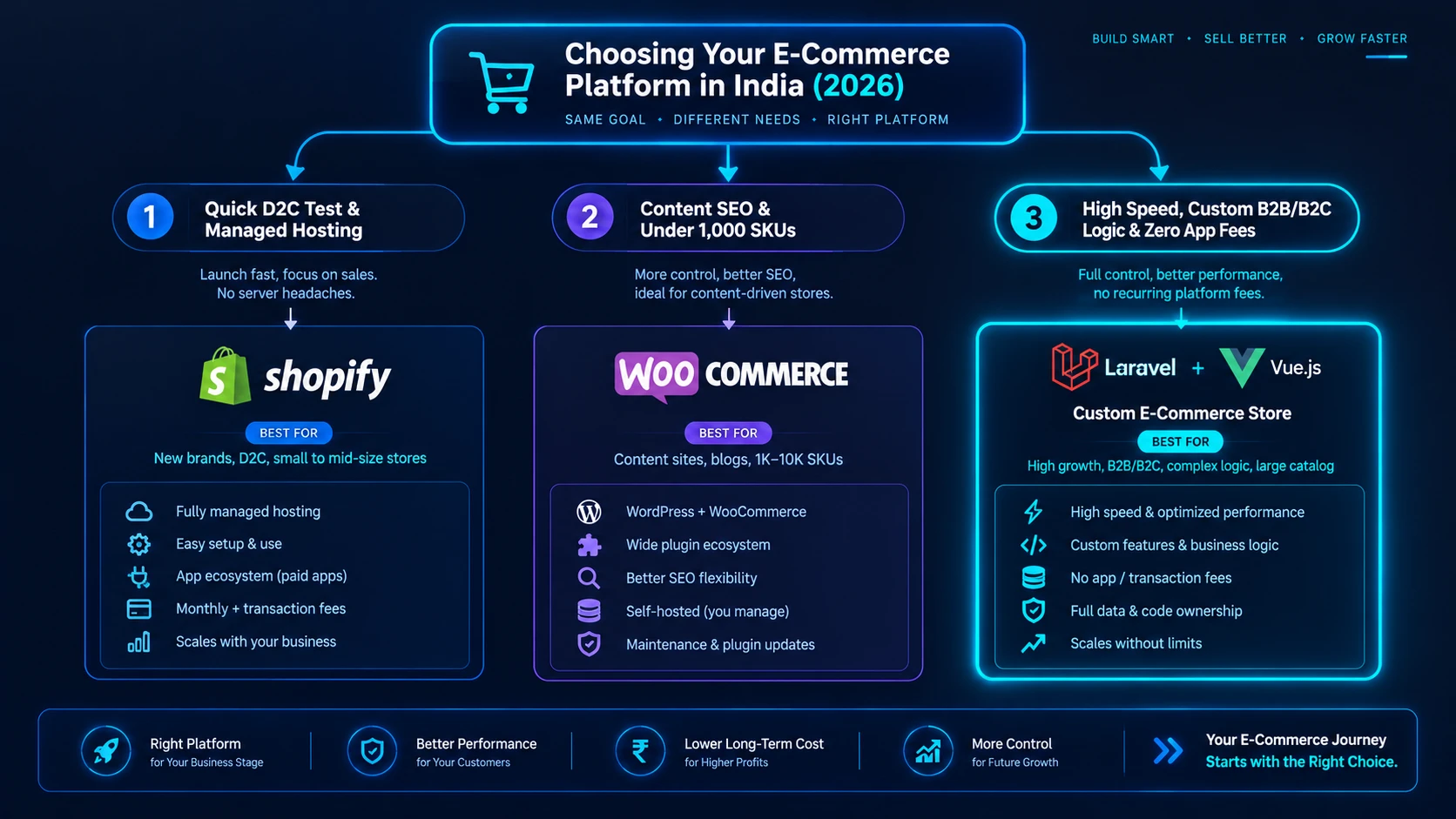
In 2026, Indian D2C brands, retail wholesalers, and growing businesses primarily choose between three architectures:
- Shopify (Hosted SaaS subscription)
- WooCommerce / WordPress (Open-source plugin ecosystem)
- Custom E-Commerce Architecture (Laravel, Next.js/Vue, or custom full-stack platforms)
Each option solves a very different business stage. This guide breaks down the actual 3-year cost in India (₹), Indian UPI and payment gateway realities, logistics automation, performance benchmarks, and a practical decision framework to help you choose the right foundation.
⚡ Quick Verdict: Which E-Commerce Platform Should You Choose in 2026?
- Choose Shopify if: You are launching a fast D2C brand or testing product-market fit with standard catalog requirements, want hosting handled for you, and are comfortable paying recurring monthly subscription fees plus third-party app charges in USD/INR.
- Choose WooCommerce if: You have a content-heavy catalog under 500–1,000 SKUs, want full ownership of your code without monthly platform commissions, and have access to reliable managed VPS hosting and technical maintenance.
- Choose Custom E-Commerce (Laravel / Vue / Modern Stack) if: You need sub-second page speeds, zero recurring app taxes, complex B2B/B2C pricing rules, multi-vendor workflows, custom ERP/inventory sync, or automated WhatsApp CRM and 1-step Indian checkout flows built directly into your core system.
1. Why Platform Selection in India Is Different From Western Markets
Most online comparisons between Shopify, WooCommerce, and custom builds are written for US or European merchants. However, operating an e-commerce business in India involves unique operational and technical challenges:
- UPI Dominance & Payment Drop-Offs: Over 75% of digital retail transactions in India happen via UPI (PhonePe, GPay, Paytm, Cred). If your checkout requires three redirects to generate a UPI intent link on mobile, cart abandonment spikes immediately.
- The Cash-on-Delivery (COD) & RTO Problem: Indian stores still see 40% to 65% COD orders depending on the category. Without automated WhatsApp COD verification, address validation, and RTO (Return to Origin) risk scoring at checkout, shipping losses can wipe out margins.
- Multi-Rate GST & HSN Invoicing: Indian businesses need automated CGST, SGST, and IGST calculations based on customer state codes, along with B2B GSTIN input fields and HSN-compliant PDF tax invoices.
- Dollar-Denominated App Costs: While Shopify offers localized base plan pricing in India, almost all essential conversion, upsell, review, and subscription apps charge in USD ($15 to $99/month per app), which quickly inflates monthly overhead for Indian SMEs.
2. At-a-Glance Comparison: Shopify vs WooCommerce vs Custom E-Commerce (2026)
| Feature / Criteria | Shopify (SaaS) | WooCommerce (WordPress) | Custom E-Commerce (Laravel / Vue / Full-Stack) |
|---|---|---|---|
| Ownership Model | Rented (Monthly SaaS lease) | Self-Hosted Open Source | 100% Proprietary Ownership |
| Time to Launch | 1 to 3 Weeks | 2 to 5 Weeks | 4 to 10 Weeks (Scope dependent) |
| Monthly Platform & App Fees | High (₹2,000 to ₹25,000+/mo with apps) | Low–Medium (VPS + annual premium plugins) | Zero App Taxes (Server hosting only) |
| Transaction Fees | 0.5% to 2% extra (beyond gateway fee) | 0% Platform Fee (Only gateway fee) | 0% Platform Fee (Only gateway fee) |
| Checkout Customization | Restricted (Unless on Shopify Plus at ₹1.7L+/mo) | High (Requires plugin/PHP customization) | Unlimited (Native 1-step UPI/OTP checkout) |
| PageSpeed & TTFB | Good (Slows down as apps are added) | Variable (Often bloated without tuning) | Ultra-Fast (< 0.4s TTFB, 95–99+ PageSpeed) |
| Catalog Scalability | Smooth up to 10,000+ SKUs | Struggles above 2,000–3,000 SKUs without DB tuning | Engineered for 50,000 to 1M+ SKUs |
| B2B / Custom Pricing Logic | Requires expensive apps or Shopify Plus | Possible via heavy plugin stacking | Native (Tiered wholesale, dealer portals, MOQ) |
| Security & Maintenance | Managed by Shopify | High (Frequent plugin/core updates required) | Enterprise-grade (Clean codebase, no public plugin exploits) |
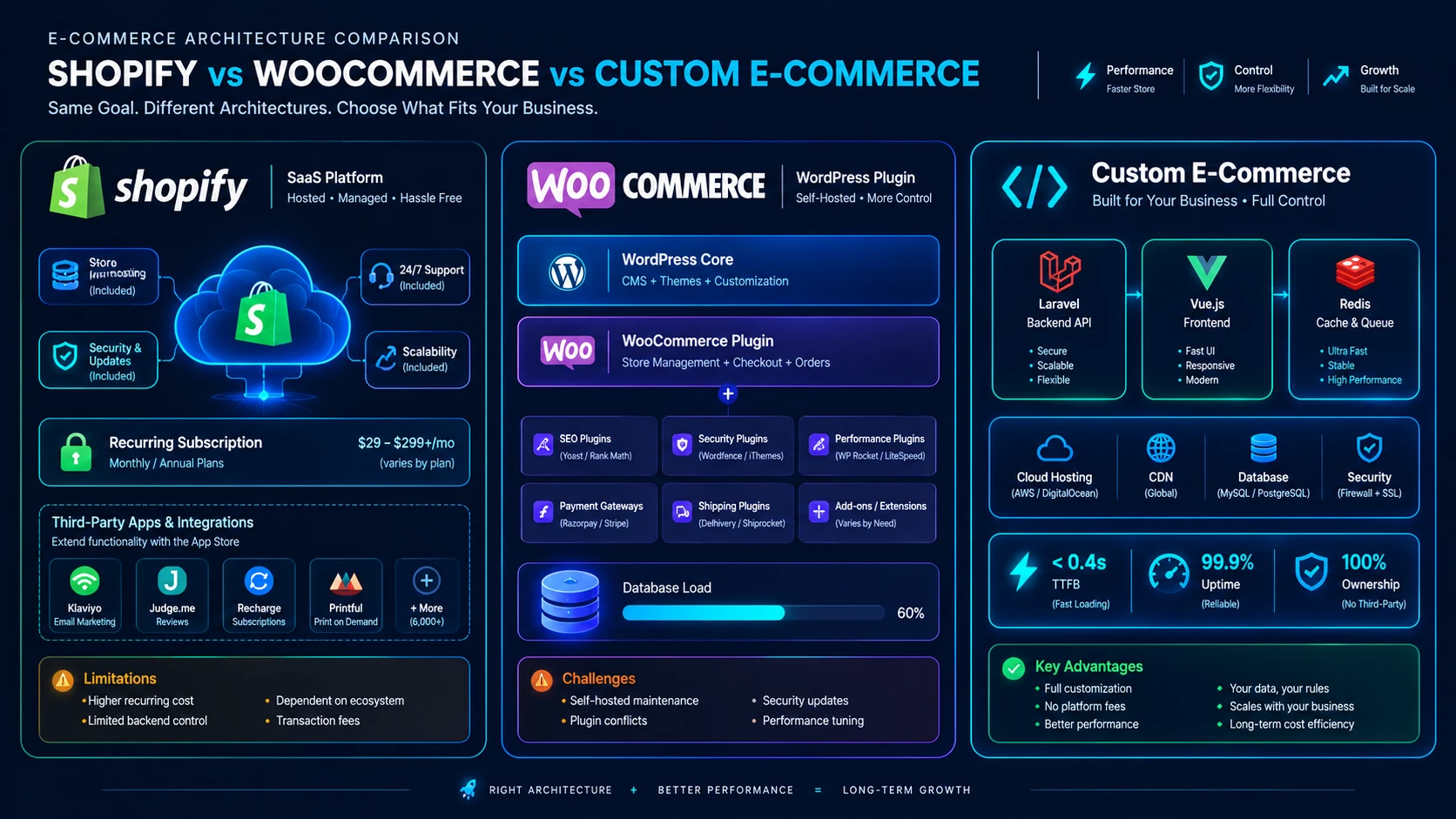
3. Deep Dive 1: Shopify in India (2026)
Shopify is the go-to hosted platform for quick-launch D2C brands in fashion, cosmetics, and lifestyle accessories. You do not need to manage servers, SSL certificates, or core security patches.
Where Shopify Excels
- Rapid Go-To-Market: A clean, functional storefront can be configured and launched in days.
- Managed Infrastructure: Traffic spikes during festive sales or Instagram reel virality are handled automatically by Shopify’s global CDN and server infrastructure.
- Indian Ecosystem Integrations: Ready-made plugins exist for Razorpay, Cashfree, Shiprocket, Pickrr, and third-party checkout accelerators like GoKwik or Shopflo.
The Hidden Realities of Shopify for Indian Businesses
- The "App Tax" Trap: Out of the box, Shopify is minimal. Want product reviews with photos? Add an app ($15/mo). Want GST-compliant invoices? Add an app ($10/mo). Want bundle discounts, WhatsApp notifications, return portals, and advanced filters? Suddenly, a ₹1,994/month Basic plan turns into a ₹12,000 to ₹22,000/month recurring bill.
- Extra Transaction Commissions: Because Shopify Payments is not natively available in India, Shopify charges an additional third-party transaction fee (0.5% to 2%) on top of the 2% fee charged by Razorpay, Cashfree, or PayU. On ₹20 Lakh monthly revenue, a 1.5% platform penalty equals ₹30,000/month (₹3.6 Lakh/year) in pure margin loss.
- Locked Checkout Architecture: On standard Shopify plans, you cannot modify the core checkout flow without paying for third-party checkout layers (which charge a percentage of GMV) or upgrading to Shopify Plus (starting around $2,300/month or ~₹1.9 Lakh/month).
- Rigid URL & SEO Structure: Shopify enforces fixed URL paths like /collections/, /products/, and /pages/. If you want deep semantic SEO silos or custom regional landing pages, Shopify's rigid URL hierarchy can be limiting.
4. Deep Dive 2: WooCommerce (WordPress) in India (2026)
WooCommerce powers a massive share of small-to-midsize Indian online stores because it combines WordPress’s content capabilities with zero platform commission fees.
Where WooCommerce Excels
- Full Code & Data Ownership: Your database, customer records, and files live on your own server. Nobody can abruptly suspend your store or hike monthly subscription tiers.
- No Additional Transaction Penalties: You only pay your Indian payment gateway fee (typically ~1.8% to 2% on cards/netbanking and 0% on standard UPI via select aggregators).
- Superior Content & Blog SEO: If your customer acquisition strategy relies heavily on organic search, long-form buying guides, and custom URL structures, WordPress + WooCommerce gives you complete control over technical SEO and schema markup.
Where WooCommerce Struggles as You Scale
- Plugin Conflict & Database Bloat: WooCommerce stores traditional product and order metadata across WordPress database tables (
wp_postmeta). Even with High-Performance Order Storage (HPOS), installing 25 to 35 plugins from different developers leads to slow database queries, high CPU usage on servers, and broken checkouts after plugin updates. - Performance Degradation Under Ad Traffic: Cached pages load fast for casual readers, but e-commerce cart and checkout pages cannot be statically cached. When 150 users hit "Add to Cart" simultaneously from a Meta ad campaign, poorly optimized WooCommerce setups crash or take 5–8 seconds per action.
- Ongoing Maintenance Overhead: WordPress and WooCommerce require consistent website maintenance, security hardening, firewall rules, and staging tests to prevent vulnerabilities in third-party plugins.
5. Deep Dive 3: Custom E-Commerce Architecture (Laravel, Vue, Next.js)
For established retailers, high-volume D2C brands, B2B manufacturers, and specialized marketplaces, custom engineering using modern frameworks like Laravel, Vue.js, Tailwind CSS, and MySQL/Redis changes the unit economics of e-commerce completely.
Why Growing Indian Brands Move to Custom E-Commerce
- Sub-Second Speed & High Conversion Rates: Custom stores are engineered with indexed relational database tables, Redis inventory caching, and zero bloated plugin scripts. Response latency stays under 0.4 seconds, directly improving mobile conversion rates and lowering Meta/Google Ads CPA.
- Zero Monthly App Subscriptions or GMV Taxes: Features like GST invoicing, pincode serviceability checks, tiered wholesale pricing, product bundles, abandoned cart recovery, and dynamic coupon engines are built natively into your application. You pay ₹0 in monthly plugin fees.
- Custom 1-Step Indian Checkout: Instead of forcing customers through a 3-page western email-first checkout, you can build a mobile-number-first OTP + 1-Click UPI Intent checkout tailored specifically for Indian buyers.
- Native WhatsApp Cloud API & CRM Sync: Rather than paying middlemen ₹5,000–₹15,000/month for WhatsApp tools, a custom platform connects directly to the official Meta WhatsApp Cloud API for automated order confirmations, COD-to-Prepaid conversion links, shipping tracking alerts, and abandoned cart nudges.
- Tailored Business Logic: Whether you sell custom-sized blinds by square feet, pharmaceuticals requiring prescription uploads, B2B bulk packs with distributor credit limits, or hyperlocal multi-branch grocery deliveries, custom code adapts to your business—not the other way around.
When Custom E-Commerce Is Not the Right Fit
If your initial total budget is under ₹40,000 and you simply want to test 10 products on Instagram next week, custom engineering is overkill. Start lean, validate demand, and migrate when recurring fees or platform limits start hurting growth.
(For a full breakdown of how development pricing works across different tiers, read our detailed guide on Website Development Cost in India 2026.)
6. Real 3-Year Total Cost of Ownership (TCO) in India (INR Breakdown)
Most business owners only compare the Day 1 setup cost and ignore the 3-year operational cost. Let’s look at a realistic comparison for a growing Indian e-commerce business generating ₹10 Lakh/month in online sales (₹1.2 Crore/year):
| Cost Component (In INR ₹) | Shopify (Growing D2C Setup) | WooCommerce (Managed Professional Setup) | Custom E-Commerce (Laravel / Full-Stack) |
|---|---|---|---|
| 1. Initial Design & Setup Cost | ₹35,000 – ₹75,000 | ₹45,000 – ₹95,000 | ₹90,000 – ₹2,50,000+ (One-Time Asset) |
| 2. Platform Subscription (3 Years) | ₹72,000 – ₹2,70,000 (Basic to Grow Plan) | ₹0 (Open Source) | ₹0 (100% Owned Code) |
| 3. Cloud Hosting / VPS (3 Years) | Included in SaaS fee | ₹54,000 – ₹1,08,000 (Managed Cloud VPS) | ₹54,000 – ₹1,20,000 (High-Speed Cloud VPS) |
| 4. Paid Apps / Plugins (3 Years) | ₹2,88,000 – ₹5,40,000 (₹8k–₹15k/mo for GST, reviews, upsell, WhatsApp, returns) | ₹45,000 – ₹90,000 (Annual premium plugins) | ₹0 (Built natively into your system) |
| 5. Extra Platform Transaction Fee (3 Years @ ₹10L/mo sales) | ₹3,60,000 – ₹7,20,000 (1%–2% extra fee over gateway) | ₹0 (Only standard gateway fee) | ₹0 (Only standard gateway fee) |
| 6. Technical Maintenance & Updates (3 Years) | ₹36,000 – ₹72,000 | ₹54,000 – ₹1,08,000 | ₹45,000 – ₹90,000 |
| Estimated 3-Year Total Outflow | ₹7.91 Lakh – ₹16.77 Lakh | ₹1.98 Lakh – ₹4.01 Lakh | ₹1.89 Lakh – ₹4.60 Lakh |
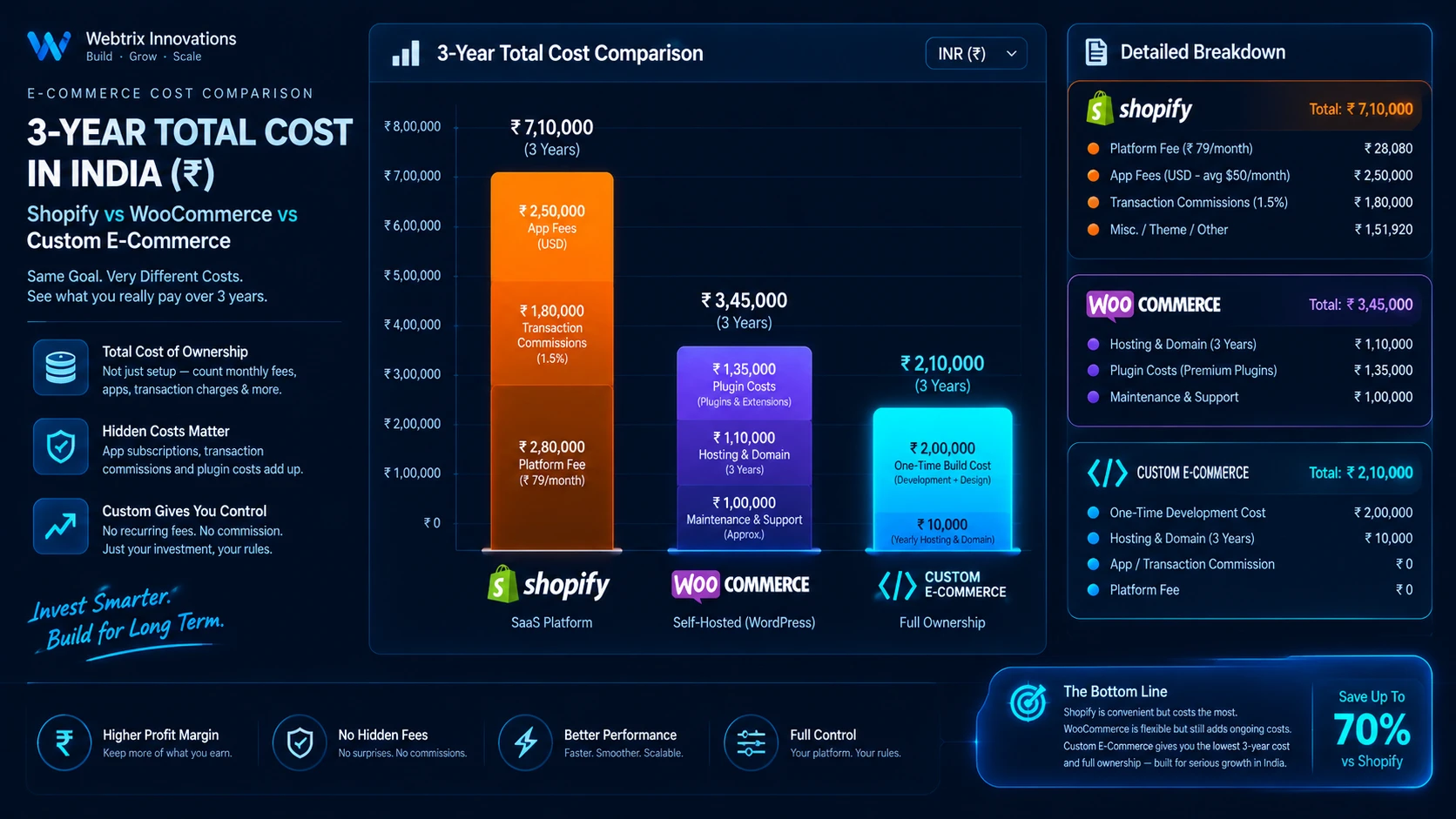
Key Takeaway: While a custom e-commerce development build has a higher upfront engineering investment, it frequently becomes 3x to 4x cheaper than Shopify over a 24-to-36-month period once you factor out USD app subscriptions and extra transaction commissions.
7. Essential Indian E-Commerce Integrations You Must Plan For in 2026
Regardless of the platform you select, your store will underperform in the Indian market without these five foundational integrations:
1. Native UPI Intent & Smart Payment Routing
Choose an Indian payment aggregator (Razorpay, Cashfree, PayU, or PhonePe Payment Gateway) that supports Direct UPI Intent on mobile browsers. When a buyer taps Google Pay or PhonePe on your checkout screen, it should directly open the app on their phone without asking them to type a VPA ID (name@okaxis) manually.
2. Automated Shipping Aggregators & Pincode Checkers
Integrate directly via API with Shiprocket, Delhivery, BlueDart, or NimbusPost. Your product page should allow users to enter their 6-digit Indian pincode to see exact estimated delivery dates and COD availability before adding items to the cart.
3. COD Verification & RTO Reduction Workflows
To protect profit margins from fake COD orders:
- Trigger an automated WhatsApp confirmation message immediately after a COD order is placed.
- Offer an instant ₹50 or 5% discount link on WhatsApp to convert the COD order into a Prepaid UPI order before dispatch.
- Flag incomplete addresses (missing house numbers or landmarks) automatically at checkout.
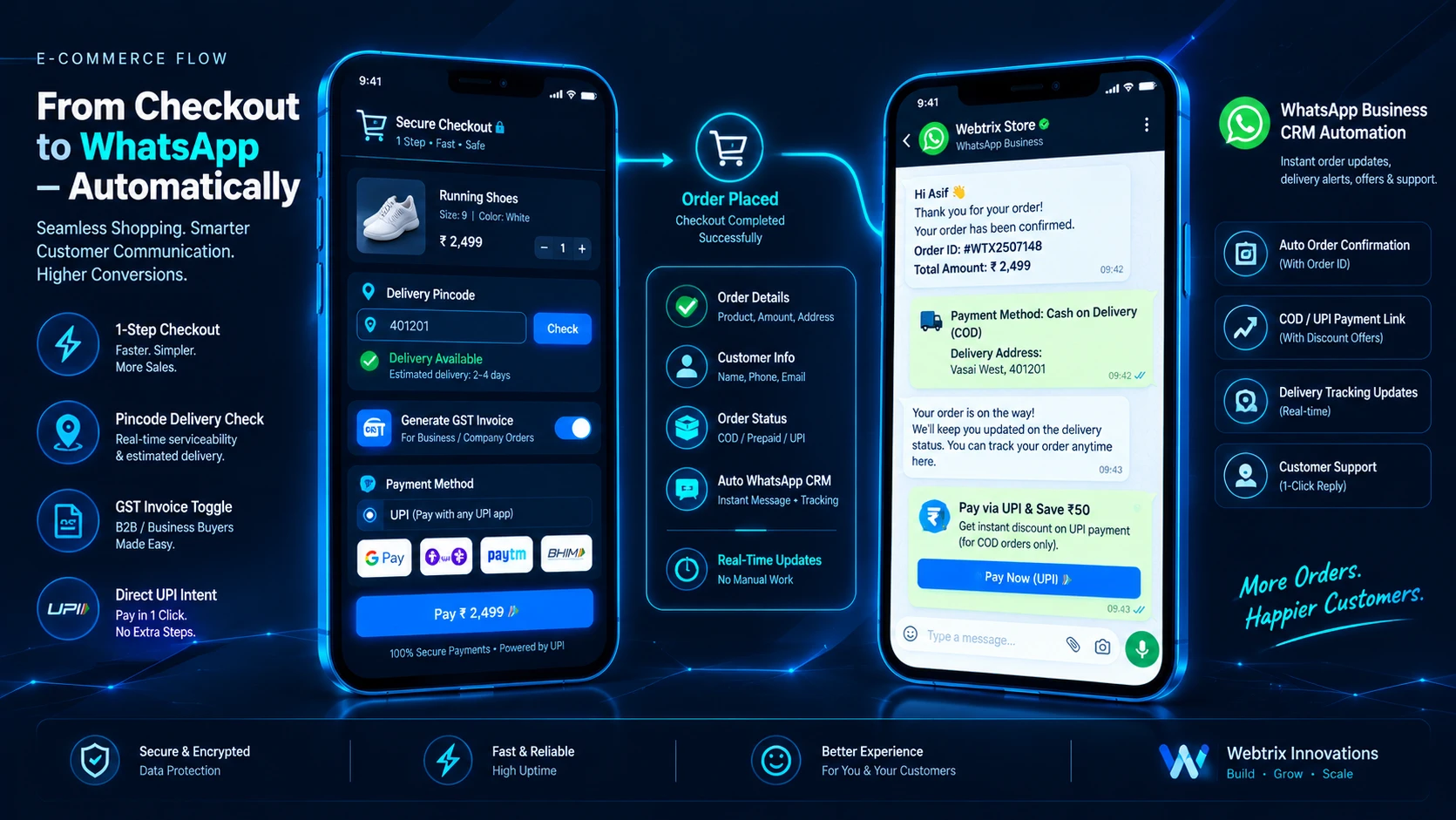
4. Automated GST Tax Engine & B2B GSTIN Support
Ensure your platform dynamically splits taxes into CGST + SGST (for intra-state orders, e.g., within Maharashtra) and IGST (for inter-state orders), supports multiple tax slabs (5%, 12%, 18%, 28%) within the same cart, and generates downloadable tax invoices automatically.
5. AI Search & Product Schema Readiness
In 2026, buyers increasingly ask ChatGPT, Google AI Mode, and Perplexity for product comparisons ("Best ergonomic office chair under ₹15,000 in India"). Your product pages must output clean JSON-LD Product Schema including price, priceCurrency (INR), availability, shippingDetails, hasMerchantReturnPolicy, and verified aggregateRating.
(Learn how to optimize your store for AI engines in our guide: How to Get Your Business Recommended by ChatGPT, Google AI Mode & Perplexity in 2026.)
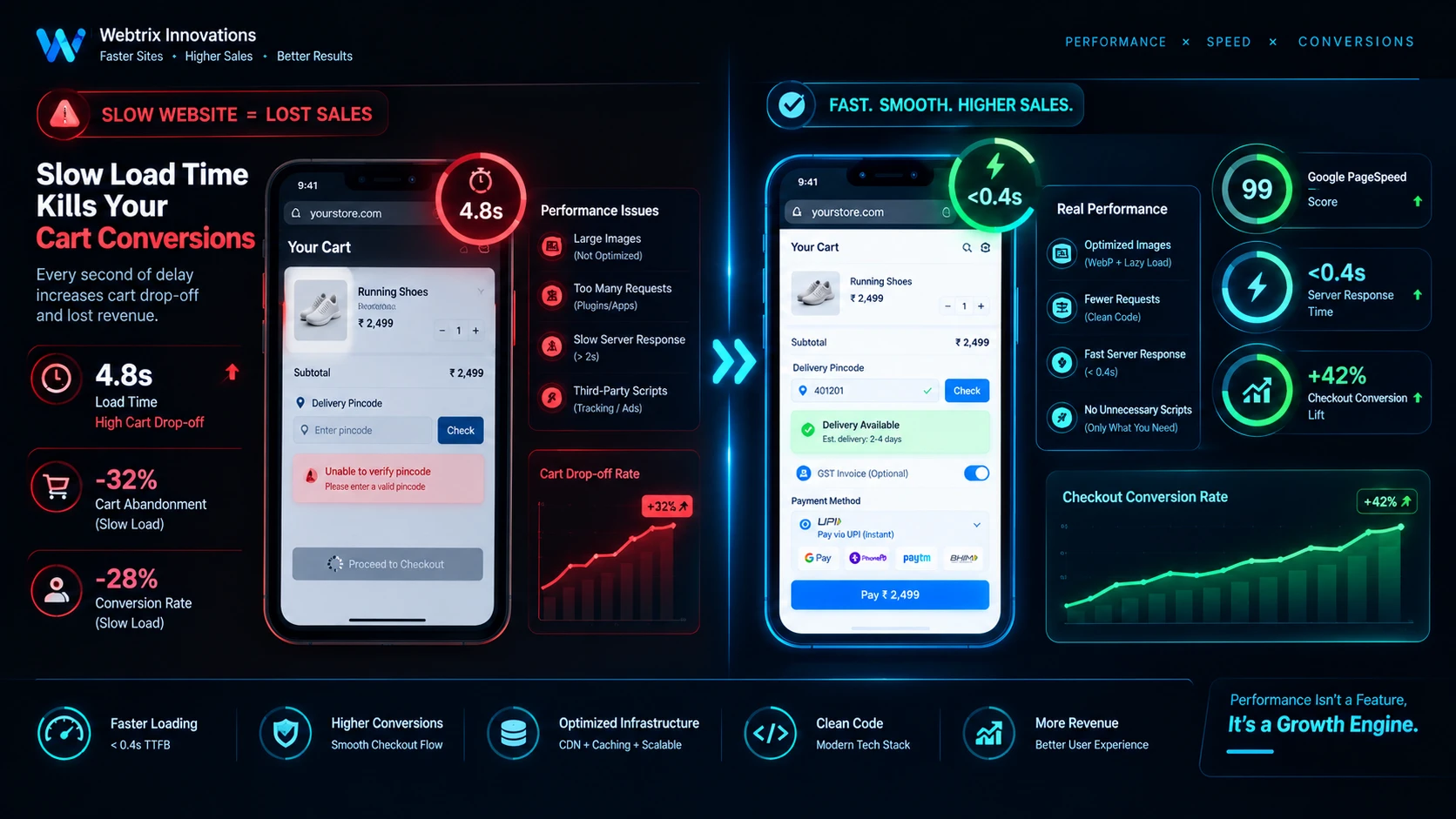
8. Fixing the Conversion Leak: Why Traffic Alone Doesn't Equal Orders
Many Indian business owners spend lakhs on Meta and Google Ads, bring visitors to their product pages, and wonder why sales remain flat. Often, the culprit isn't the product—it is checkout friction and poor UX ergonomics.
If your store suffers from high cart abandonment, audit these critical areas:
- Forced Account Creation: Never force a first-time buyer to create a password before purchasing. Use guest checkout or mobile OTP login.
- Hidden Shipping & Tax Surprises: Showing a product for ₹999 and unexpectedly adding ₹180 GST + ₹120 shipping on the final payment screen causes immediate drop-offs.
- Slow Mobile Core Web Vitals: If your product gallery scripts block the main thread on mid-range Android devices, users bounce before the "Buy Now" button becomes interactive.
(If your current site gets visitors who leave without buying or enquiring, read our diagnostic guide: Why Is Your Business Website Not Generating Leads? 15 Reasons & Fixes (2026).)
9. Decision Framework: How to Choose the Right Option for Your Business
Use this simple checklist to make a confident decision:
Choose Shopify If:
- You want to launch a standard D2C catalog within 2 weeks with minimal technical involvement.
- You have fewer than 500 standard products with simple variants (size/color).
- You are comfortable paying recurring monthly fees for apps and platform transaction charges in exchange for hands-off hosting.
Choose WooCommerce If:
- You are an SME or content-driven brand with under 1,000 SKUs looking for low monthly overhead and full ownership.
- You want strong blogging/content marketing capabilities alongside your store.
- You have a trusted agency or technical partner to manage VPS hosting, speed optimization, and security updates.
Choose Custom E-Commerce Development If:
- You want ultra-fast performance (< 0.4s response times), complete design freedom, and zero monthly app or transaction commissions.
- You require custom business workflows—such as B2B wholesale portals, custom product calculators, multi-vendor marketplaces, ERP/Tally synchronization, or deep WhatsApp CRM automation.
- You view your e-commerce platform as a long-term proprietary business asset engineered to scale without hitting plugin walls.
10. Frequently Asked Questions (FAQs)
1. Which e-commerce platform is best for Indian startups in 2026?
It depends on your business model and 24-month roadmap. Shopify is great for quick D2C validation if you accept recurring monthly app costs. WooCommerce suits content-first SMEs wanting full ownership on a moderate budget. Custom Laravel/Vue e-commerce is best for businesses prioritizing fast mobile speed, custom checkout flows, B2B/B2C flexibility, and zero recurring platform commissions.
2. Does Shopify charge extra transaction fees in India?
Yes. Because Shopify Payments is not available in India, Shopify charges an additional third-party transaction fee of 0.5% to 2% (depending on your monthly plan) on top of the standard ~2% fee charged by Indian payment gateways like Razorpay, Cashfree, or PayU. Neither WooCommerce nor custom e-commerce platforms charge this extra platform commission.
3. How much does it cost to build an e-commerce website in India in 2026?
A professional Shopify or WooCommerce store typically costs between ₹35,000 and ₹95,000 depending on custom UI/UX design, catalog size, and payment/shipping integrations. A custom-engineered e-commerce platform (built on Laravel, Vue, or Next.js with custom admin dashboards and WhatsApp CRM automation) generally ranges from ₹90,000 to ₹2,50,000+ depending on technical complexity.
4. Can I integrate Indian UPI, Razorpay, and Shiprocket with a custom e-commerce website?
Yes. In fact, custom e-commerce platforms allow deeper, faster native API integrations with Razorpay, PhonePe PG, Cashfree, Shiprocket, Delhivery, and Meta WhatsApp Cloud API—without relying on bloated third-party middleman plugins that slow down your site or charge monthly fees.
5. Is WooCommerce too slow for large e-commerce stores?
Out-of-the-box WooCommerce on shared hosting becomes slow once you cross 1,000+ products or install 25+ plugins. However, on a tuned Cloud VPS with Redis object caching and clean code, WooCommerce performs well for mid-sized stores. For large catalogs (5,000 to 100,000+ SKUs) or high concurrency, a custom Laravel/MySQL architecture is significantly faster and more stable.
6. Can I migrate my store from Shopify or WooCommerce to a custom platform later without losing SEO rankings?
Yes. With a structured migration plan—including complete product/customer database migration, canonical mapping, schema preservation, and 1:1 301 permanent redirects—you can transition to a custom platform while preserving (and often boosting) your Google search rankings due to improved Core Web Vitals.
Editorial & Engineering Review
Written & Reviewed by the Webtrix Innovations Engineering Team
Full-stack Laravel, Vue & E-Commerce architects based in Vasai, Mumbai (MMR), building high-converting online stores for Indian businesses. Every recommendation in this guide is derived from production deployment telemetry, real payment gateway API integrations, and client TCO audits across Indian retail and D2C brands.
Ready to Build or Scale Your E-Commerce Store?
Choosing the right architecture today saves lakhs in rebuild costs and lost conversions tomorrow. At Webtrix Innovations, we engineer high-converting e-commerce storefronts—from conversion-optimized Shopify and WooCommerce setups to lightning-fast Custom Laravel & Vue E-Commerce Platforms with native UPI checkouts and automated WhatsApp CRM workflows.
Planning an e-commerce store or custom checkout in India?
Explore our e-commerce engineering services for fast storefronts, UPI integrations, and scalable architectures.
About Webtrix Innovations
Webtrix Innovations designs and develops modern websites, web applications, e-commerce stores, and digital marketing strategies for growing businesses.


