Google Gemini 4 Argon: What It Is, Key Features, Availability & What It Means for Businesses
Google Gemini 4 Argon explained: 1M-token limit, coding, cybersecurity, pricing, availability and what the frontier model means for businesses.
Google has introduced Gemini 4 Argon, a new frontier AI model designed for complex, long-running professional work.
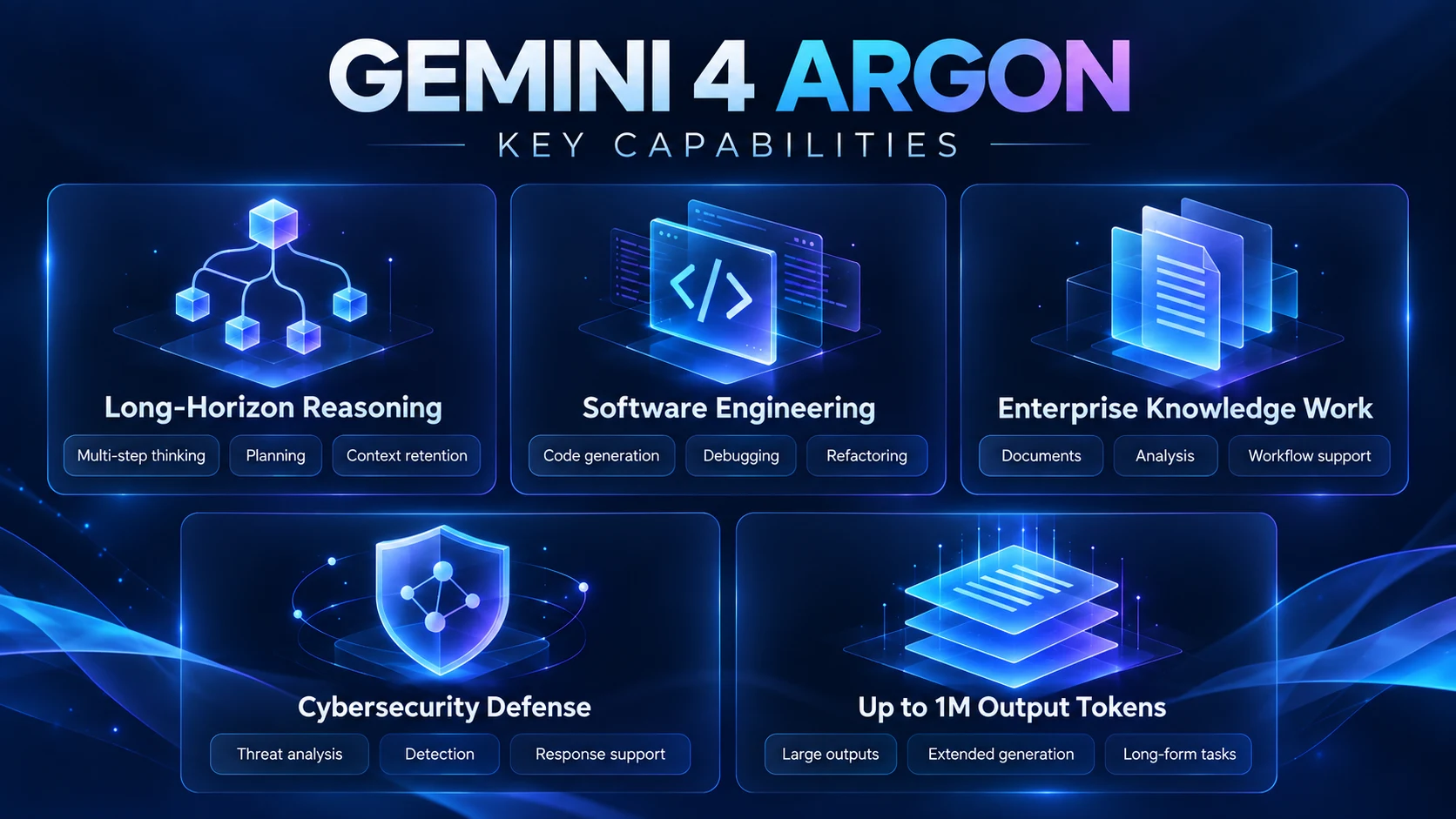
Unlike AI models positioned mainly around quick answers, short content generation or everyday assistance, Gemini 4 Argon is being presented as a model capable of sustaining deeper reasoning across multi-step workflows involving software engineering, financial research, legal work and cybersecurity defense.
Google announced Gemini 4 Argon on September 30, 2026. At launch, access is deliberately limited while Google gathers feedback and strengthens safeguards before expanding availability to developers, enterprises and consumers. Google's official launch announcement details these initial deployment parameters.
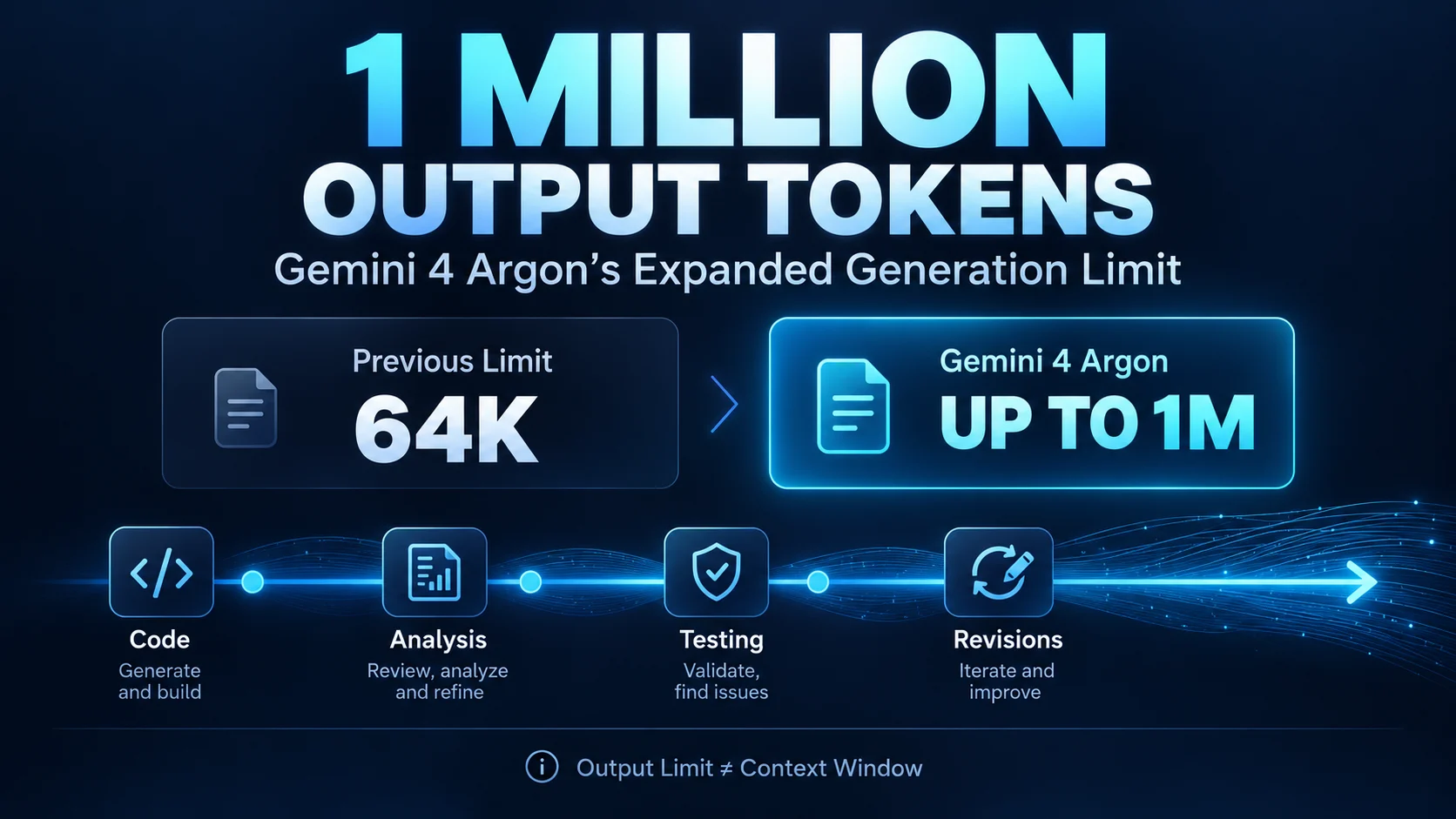
The model also introduces one particularly unusual capability: an output limit of up to 1 million tokens, substantially higher than the previous 64K-token output limit cited by Google. Launch documentation on blog.google confirms this major generation leap.
But what does Gemini 4 Argon actually do? Who can access it? And what could a model designed for long-horizon work mean for developers and businesses?
This guide breaks down the announcement without the hype.
Key Takeaways: Gemini 4 Argon at a Glance
- Announced: September 30, 2026
- Model type: Google frontier AI model
- Focus: Software engineering, enterprise knowledge work and cyber defense
- Output limit: Up to 1 million tokens according to Google’s launch announcement
- Availability: Limited rollout through the Fairwind Program
- Introductory API pricing: $2 / 1M input tokens and $10 / 1M output tokens
What Is Gemini 4 Argon?
Direct Answer: Gemini 4 Argon is Google's frontier AI model designed for deep reasoning across complex, long-horizon workflows. Google highlights software engineering, financial and legal knowledge work, cybersecurity defense and other multi-step professional tasks as major use cases.
Google describes Argon as a model built to sustain reasoning over tasks that may require many steps rather than simply generating a short response to a single prompt. Google's research briefing outlines how this architecture is optimized for sustained execution trajectories.
That distinction matters.
A traditional AI interaction might look like:
A more complex AI workflow might instead involve:
Gemini 4 Argon is being developed around that second category.
Rather than treating AI purely as a chatbot, Google is increasingly positioning frontier models as systems that can participate in longer professional workflows.
When Was Gemini 4 Argon Announced?
Google officially announced Gemini 4 Argon on September 30, 2026.
The announcement followed Gemini 3.8 Flash and Gemini 3.8 Flash Cyber, which Google introduced earlier in September.
Gemini 3.8 Flash was positioned as a faster, lower-cost model for coding, reasoning and agentic workflows, while Gemini 4 Argon moves further toward Google's frontier tier for especially difficult and long-running tasks. Google's introduction of 3.8 Flash and 3.8 Flash Cyber highlighted that balance between speed and frontier capabilities.
That does not mean Argon simply replaces every earlier Gemini model.
Different models are designed around different balances of intelligence, speed, cost and workload complexity.
Gemini 4 Argon Key Features
Google's announcement highlights several areas where Argon differs from more conventional AI models.
1. Up to 1 Million Output Tokens
One of the most unusual specifications announced for Gemini 4 Argon is its 1-million-token output limit.
Google says its previous limit was approximately 64K output tokens. Argon dramatically expands that ceiling so a model can potentially continue a reasoning or generation trajectory for much longer. Google's technical overview on blog.google emphasizes this expansion.
This is important to distinguish from a context window.
- A context window determines how much information a model can consider within an interaction.
- An output-token limit determines how much the model can generate.
Google's Gemini 4 Argon launch documentation specifically describes the 1M figure as an output-token limit.
Why Would Such a Large Output Limit Matter?
For normal tasks such as:
- writing an email,
- generating a social caption,
- answering a question,
- summarizing a short document,
one million output tokens would be unnecessary.
The benefit becomes more relevant when an AI system is allowed to work through a long sequence of reasoning, tool calls, code changes, tests and revisions.
For example, a software-engineering agent might need to:
- inspect a repository,
- understand dependencies,
- locate an issue,
- modify multiple files,
- run tests,
- investigate failures,
- modify the implementation again,
- rerun tests,
- review security implications,
- prepare documentation.
The important idea is therefore not simply “AI can write an enormous answer.”
It is that a larger generation budget can provide more room for long-running computational workflows.
2. Long-Horizon Reasoning
Google describes Gemini 4 Argon as being built to sustain deep reasoning across complex, long-horizon workflows. Google's post outlines the engineering investments behind these multi-step capabilities.
Long-horizon tasks are problems that cannot usually be completed reliably in one quick step.
Examples could include:
- debugging a difficult software issue,
- migrating a large codebase,
- researching multiple financial sources,
- analyzing legal materials,
- reviewing many documents,
- discovering and fixing security vulnerabilities.
This is increasingly important as AI evolves from chat interfaces toward agentic systems that can perform sequences of connected actions.
3. Real-World Software Engineering
Software engineering is one of the strongest themes in Google's Gemini 4 Argon announcement.
Google says its own engineers are already using Argon for tasks ranging from everyday debugging to algorithm development and large-scale codebase migrations. Google notes that internal teams deploy Argon agents across extensive engineering pipelines.
One particularly ambitious example involves C and C++ to Rust migrations.
Google reports using Argon agents on codebases ranging from tens of thousands of lines to more than 800,000 lines for the Fuchsia Zircon kernel. Google also stresses that critical migrations still undergo extensive automated testing, manual auditing and review. Official reporting confirms human verification remains mandatory.
That last point is important.
More capable AI does not eliminate the need for engineering review.
For production software, developers still need to verify:
- correctness,
- architecture,
- security,
- performance,
- backwards compatibility,
- data integrity,
- tests,
- deployment behavior.
AI can increase the amount of work that can be attempted, but production responsibility remains with the people and organizations deploying the software.
4. Enterprise Knowledge Work
Gemini 4 Argon is not being positioned only as a coding model.
Google also highlights complex knowledge work in areas such as:
- finance,
- legal research,
- legal drafting,
- tax-related work,
- business-process automation.
Google reports strong performance across third-party evaluations covering several of these areas. Benchmark documentation highlights strong enterprise evaluations.
For businesses, the interesting part is not simply whether AI can write a report.
The larger shift is toward AI systems capable of working across multiple sources and multiple stages of a professional task.
A research workflow, for example, could eventually involve:
That is substantially different from asking a chatbot to generate a paragraph from one prompt.
5. Multimodal Professional Work
Google also says Argon can work with tasks involving visual information.
Examples cited by Google include:
- professional chart analysis,
- understanding long videos,
- acting on information across collections of documents. Google launch notes demonstrate visual analysis benchmarks.
Multimodality matters because real business information rarely exists only as plain text.
Modern workflows may involve:
- PDFs,
- spreadsheets,
- screenshots,
- diagrams,
- videos,
- dashboards,
- code,
- images,
- structured databases.
AI systems that can connect information across these formats can potentially become useful in more realistic workflows.
Gemini 4 Argon and Cybersecurity
Cybersecurity is one of Gemini 4 Argon's most heavily emphasized areas.
Google says the model has been trained specifically to support defensive cybersecurity tasks and can identify, validate and patch certain software vulnerabilities. Google security disclosures emphasize vulnerability remediation capabilities.
Google is initially releasing the model to selected trusted cyber defenders through its Fairwind Program.
The reason for the controlled rollout is straightforward: advanced cybersecurity capabilities can be useful for legitimate defenders while also creating misuse risks if deployed without appropriate safeguards.
Google says its safety work around Argon includes areas such as:
- misuse prevention,
- prompt-injection resistance,
- monitoring model behavior,
- stronger sandboxing and agent-security controls. Safety documentation outlines these governance mechanisms.
What Did Google Report in Security Testing?
Google reports that Gemini 4 Argon tied for first place with a 68% score on CWE-bench v1, an evaluation focused on remediating software vulnerabilities. Google benchmark data reflects this milestone.
The company also says Argon showed improvements over Gemini 3.8 Flash Cyber in vulnerability discovery across complex codebases.
These benchmark results are useful indicators, but they should not be interpreted as guarantees that the model will identify or fix every real-world security issue.
Security still requires human review, independent testing and responsible deployment.
What Gemini 4 Argon Could Mean for Web Development
For web developers, the most interesting part of Argon may not be code generation itself.
AI has already been capable of generating individual functions, components and pages for some time.
The more significant direction is codebase-level understanding and multi-step execution.
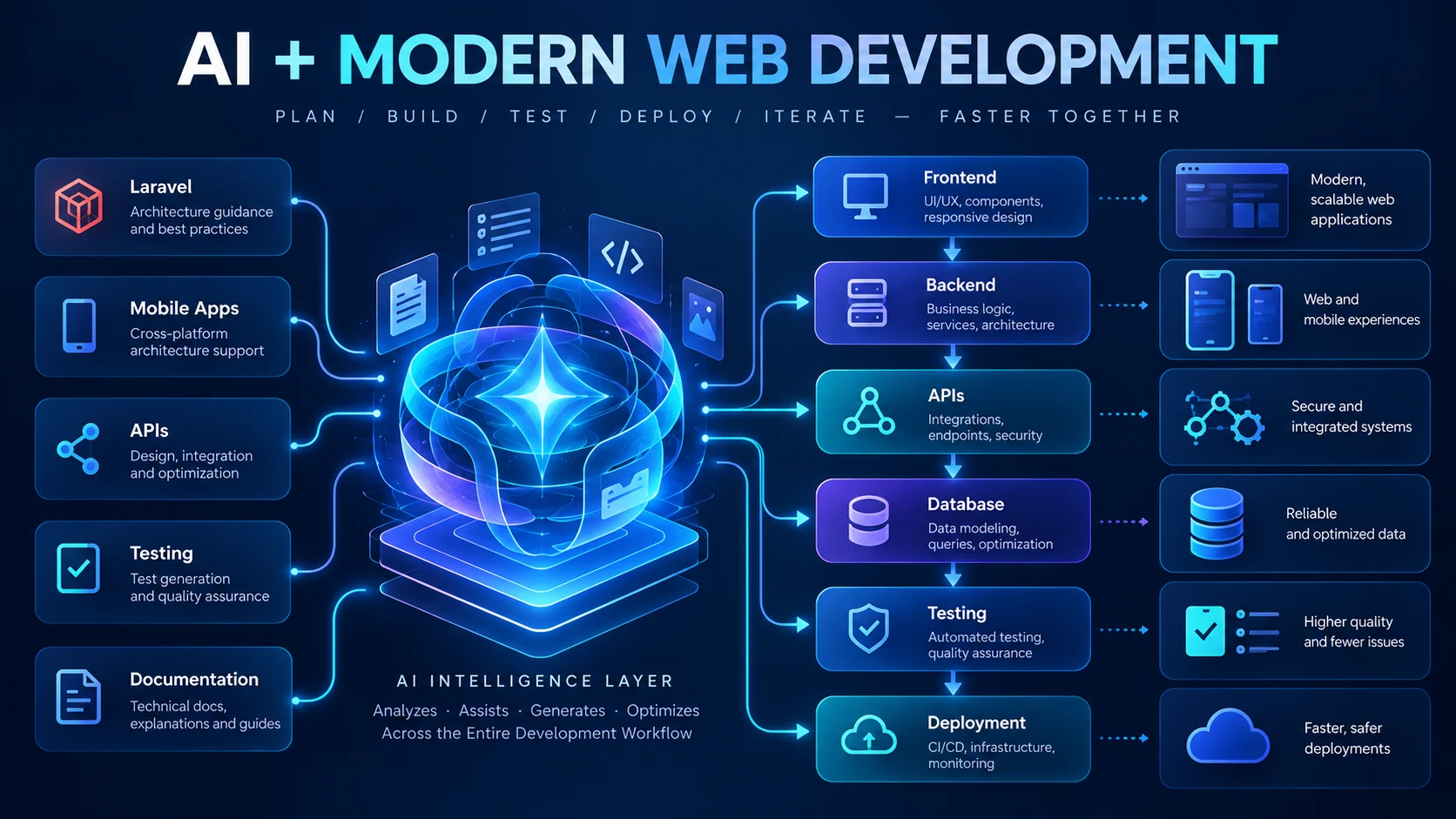
Consider a large Laravel application.
A meaningful change may involve:
- Blade templates,
- Tailwind components,
- controllers,
- service classes,
- routes,
- middleware,
- database migrations,
- models,
- APIs,
- authentication,
- validation,
- background jobs,
- notifications,
- automated tests.
Changing one area can affect several others.
An AI coding assistant that only understands one isolated file has obvious limitations.
An advanced engineering agent with sufficient reasoning capacity could instead inspect the relationships across the project, plan modifications and validate the resulting behavior.
Google's reported internal use of Argon for large codebase migrations suggests this is an important direction for frontier coding models. Google's engineering reports underline this direction.
Laravel and Custom Web Applications
For custom Laravel applications, future frontier-model workflows could potentially assist developers with tasks such as:
- tracing bugs across controllers and services,
- reviewing route and middleware relationships,
- refactoring repeated logic,
- writing or expanding automated tests,
- analyzing database migrations,
- checking API contracts,
- reviewing validation flows,
- documenting unfamiliar modules.
These are potential applications based on the type of software-engineering workflows Google describes, not a promise that Argon will independently complete every Laravel project.
Good engineering still requires deliberate architecture and validation.
Businesses needing custom websites or web applications can also explore Webtrix Innovations' Web Development Services, which focus on frontend implementation, backend functionality, APIs, databases and business workflows.
What Gemini 4 Argon Could Mean for App Development
Modern mobile applications rarely consist only of screens.
An application may connect:
It may also involve:
- authentication,
- roles and permissions,
- push notifications,
- offline synchronization,
- background tasks,
- payment integrations,
- device permissions,
- external APIs.
Webtrix Innovations' own app-development architecture reflects this layered approach, with user interfaces connected to APIs, databases, backend logic and administrative systems. You can learn more about our approach through Webtrix Innovations' App Development solutions.
A more capable AI engineering agent could potentially help teams reason across those interconnected layers rather than focusing only on isolated code snippets.
For example, implementing a notification feature might require changes to:
- mobile application logic,
- backend APIs,
- database records,
- device-token management,
- notification preferences,
- event triggers,
- automated tests.
This is exactly the type of multi-file, multi-step engineering problem where long-horizon AI systems could become more useful.
What Could Gemini 4 Argon Mean for Businesses?
Most businesses should not interpret Gemini 4 Argon as a reason to immediately replace their existing software, employees or workflows.
A more practical takeaway is that enterprise AI is becoming increasingly capable of working with processes, not only prompts.
From AI Assistant to AI Workflow
Earlier AI adoption often looked like this:
The emerging model looks more like:
Potential business applications could eventually include:
- research assistance,
- document analysis,
- software development,
- internal automation,
- compliance-support workflows,
- technical troubleshooting,
- knowledge retrieval.
But businesses should evaluate these systems according to practical requirements such as:
- reliability,
- privacy,
- security,
- cost,
- auditability,
- human oversight,
- integration requirements.
A more capable model is not automatically the correct tool for every task.
Gemini 4 Argon vs Gemini 3.8 Flash
Gemini 4 Argon and Gemini 3.8 Flash are designed around overlapping but different priorities.
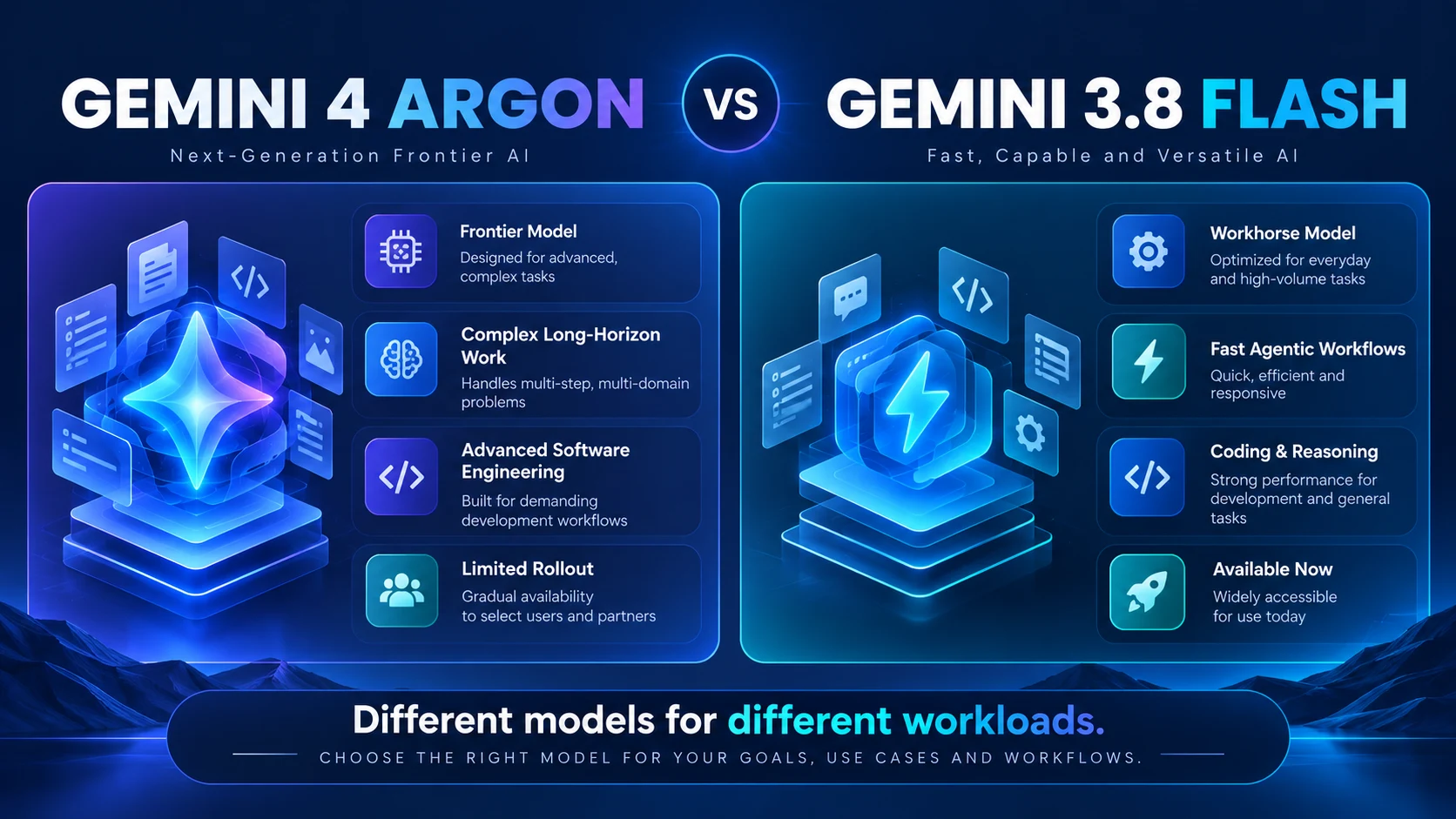
| Area | Gemini 4 Argon | Gemini 3.8 Flash |
|---|---|---|
| Positioning | Frontier model | Fast workhorse model |
| Primary focus | Most complex long-horizon workflows | Coding, agents and reasoning with stronger cost/speed balance |
| Coding | Advanced software engineering | Strong software engineering and agentic workflows |
| Cybersecurity | Frontier defensive capabilities | 3.8 Flash Cyber variant for trusted defenders |
| General availability | Limited initial rollout | Available now across several Google products |
| Output limit | Up to 1M tokens | Google does not state the same 1M limit in the cited announcement |
| API | Broader rollout planned | Available through Gemini API / AI Studio |
| Consumer access | Planned | Available to eligible Google AI Pro and Ultra subscribers |
Google introduced Gemini 3.8 Flash on September 2, 2026 and describes it as its intelligent workhorse model for software engineering, agentic workflows and multi-step reasoning. It is already available through Google AI Studio, Gemini API, Google Antigravity and other Google products. Google's Gemini 3.8 launch article details its wide availability across tools.
Argon is positioned above that for especially difficult frontier-level work.
Therefore, it would be misleading to say:
“Gemini 4 Argon replaces Gemini 3.8 Flash.”
A more accurate interpretation is:
Different Gemini models are being optimized for different combinations of capability, speed, cost and accessibility.
Gemini 4 Argon Benchmark Results
Google's launch announcement includes several benchmark results.
According to Google:
- Gemini 4 Argon scored 77.9% on DeepSWE v1.1, which evaluates long-horizon software-engineering tasks.
- It scored 51.3% on AutomationBench, a Zapier evaluation covering end-to-end business-function execution.
- It scored 91.7% on LVBench, an evaluation involving long-video understanding.
- It achieved 68% on CWE-bench v1 for software-vulnerability remediation. Google's announcement post publishes these comparative test figures.
Benchmark scores can help compare specific capabilities under controlled testing conditions.
However, they should not be treated as universal measures of real-world performance.
Actual results can vary depending on:
- prompts,
- tools,
- task complexity,
- context,
- integrations,
- safety restrictions,
- implementation quality.
The best evaluation is ultimately whether the model performs reliably on the specific workflow a business or development team needs.
Is Gemini 4 Argon Available to the Public?
Direct Answer: No, Gemini 4 Argon is not broadly available to everyone as of October 3, 2026. Google is initially providing access to selected trusted cybersecurity defenders through the Fairwind Program while preparing a broader rollout.
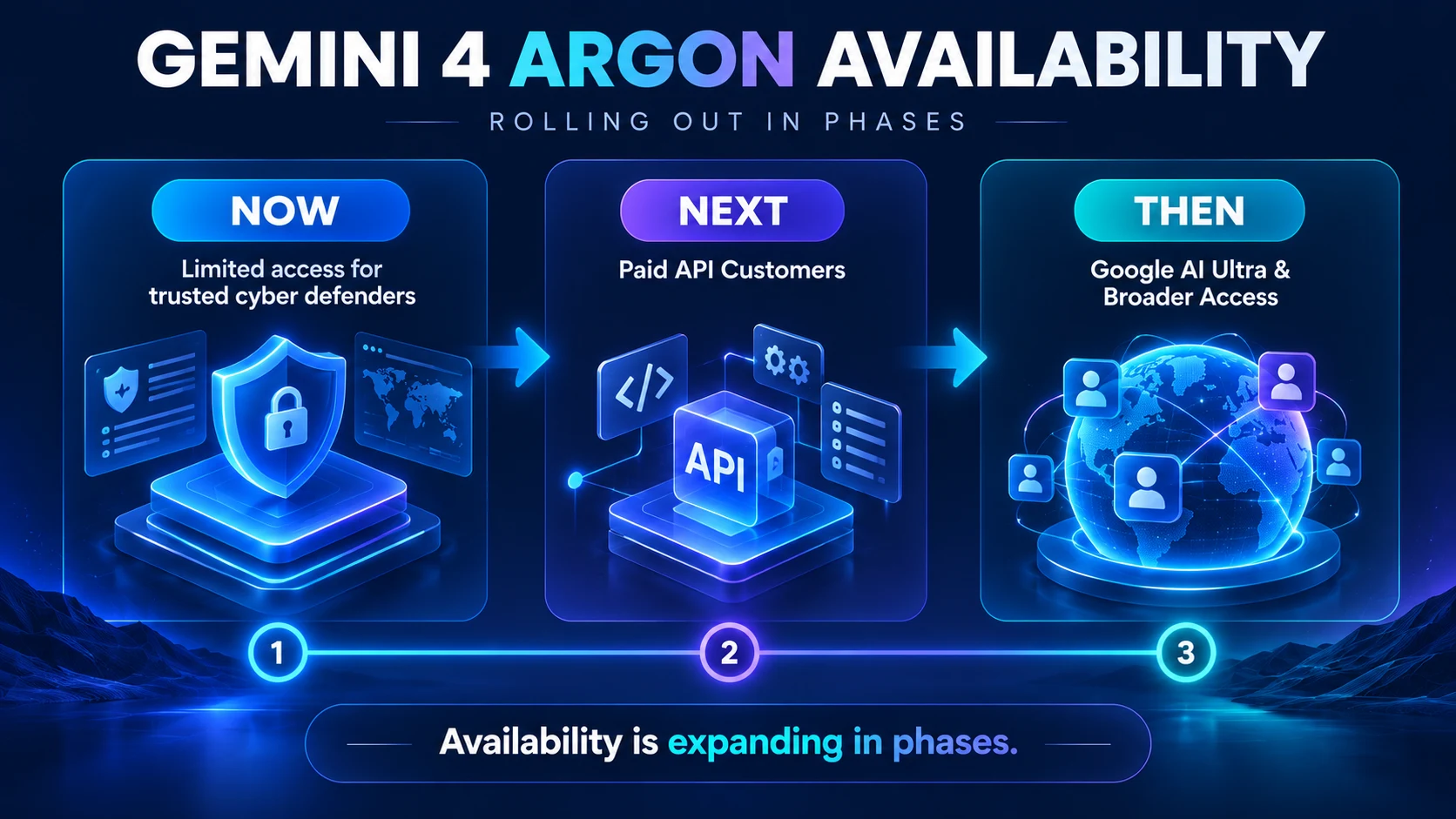
Google says it is using a phased release because frontier cybersecurity and agentic capabilities require additional safeguards and real-world testing. Google launch statements emphasize the reasoning behind this cautious rollout.
The company plans to expand access to:
- developers,
- enterprises,
- consumers.
Google says the broader rollout will begin with paid API customers and Google AI Ultra subscribers. Google rollout notes confirm these initial priority tiers.
There is not yet universal consumer access to Gemini 4 Argon.
Will Gemini 4 Argon Be Available Through an API?
Google says developers will be included in Gemini 4 Argon's broader rollout.
The first wider-access groups are expected to include paid API customers and Google AI Ultra subscribers. Launch disclosures indicate developers will access Argon through standard Google AI API pathways.
However, because rollout is still phased, businesses should check Google's current developer documentation before designing a production system specifically around Argon.
Availability can change quickly after a frontier-model launch.
Gemini 4 Argon Pricing
Google has also announced introductory pricing for Gemini 4 Argon.
At launch, Google lists:
| Usage | Introductory Price | Standard Price (Planned) |
|---|---|---|
| Input tokens | $2 per 1 million tokens | $4 per 1 million tokens |
| Output tokens | $10 per 1 million tokens | $20 per 1 million tokens |
| Cached input | 95% discount from input-token price | 95% discount from input-token price |
Google says that after the introductory period, pricing is planned to increase to:
- $4 per 1M input tokens
- $20 per 1M output tokens Google pricing notes specify the long-term price structure.
Pricing should always be rechecked before production deployment because model pricing can change.
What Is Gemini 4 Argon Used For?
Direct Answer: Google is positioning Gemini 4 Argon for complex software engineering, financial research, legal research and drafting, enterprise automation, multimodal analysis and defensive cybersecurity.
The common pattern across these use cases is complexity over time.
They involve more than generating one isolated answer.
A typical Argon-style workflow could require the model to:
- inspect information,
- identify relevant material,
- reason about dependencies,
- use tools,
- perform an action,
- evaluate the result,
- correct mistakes,
- continue until the objective is reached.
That agentic pattern is likely to become increasingly important across professional AI systems.
Does Gemini 4 Argon Have a 1M Context Window?
Direct Answer: Google’s official Gemini 4 Argon launch article explicitly states that the model’s output-token limit has increased from 64K to 1 million tokens. However, Google’s September 2026 AI roundup separately describes Argon as having a 1-million-token context window. Because output limits and context windows are different specifications, these two official Google descriptions should not be treated as interchangeable. Until Google clarifies the specification further, the safest approach is to cite the wording of each source separately.
This distinction is important because the two specifications measure different technical parameters:
- A context window measures how much information a model can process or consider across prompts, documents and history.
- An output-token limit measures how much text, reasoning trace, code and tool execution data the model can generate in a single trajectory.
In Google's official Gemini 4 Argon launch announcement, Google highlights that the model's output limit has expanded from 64K to up to 1 million tokens for long-horizon workflows. Meanwhile, Google's September 2026 AI updates roundup separately references Argon alongside a 1-million-token context window.
Because these specifications affect different parts of system architecture, developers and enterprise teams should distinguish between them and refer to the specific phrasing in each official Google source rather than assuming they are interchangeable.
Should Businesses Prepare for Frontier AI Workflows?
Yes—but preparation does not mean adopting every new model immediately.
A better approach is to prepare the underlying digital systems that AI tools will eventually need to work with.
1. Keep Business Data Structured
AI systems are more useful when information is organized and accessible.
Businesses should reduce unnecessary dependence on:
- disconnected spreadsheets,
- undocumented workflows,
- inconsistent records,
- manual repetitive processes.
2. Use APIs Where Appropriate
Well-designed APIs make it easier for applications, automation platforms and future AI agents to interact safely with business systems.
3. Maintain Clean Software Architecture
A maintainable codebase helps both human developers and AI-assisted development tools understand and modify systems more reliably.
4. Keep Human Review
High-impact tasks should continue to use approval workflows, testing and human oversight.
5. Think in Workflows, Not AI Features
Instead of asking:
“How can we add AI?”
Ask:
“Which workflow is currently slow, repetitive or difficult, and could AI responsibly assist with part of it?”
That leads to much more useful AI adoption.
Gemini 4 Argon and the Bigger Shift Toward AI Agents
Gemini 4 Argon is part of a wider change occurring across AI platforms.
AI systems are gradually moving beyond simple chat.
The progression looks something like:
That does not mean every AI model will become completely autonomous.
Instead, it means models are increasingly being designed to:
- reason for longer,
- use tools,
- inspect results,
- make corrections,
- work across different data types,
- continue toward an objective.
For businesses and developers, that transition may eventually matter more than improvements to simple question-answering benchmarks.
AI Search Is Changing Too
AI models are also changing how customers discover information online.
Traditional search remains important, but people increasingly interact with search through:
- conversational AI,
- AI-generated summaries,
- AI Mode,
- research assistants,
- generative search systems.
Webtrix Innovations has previously covered this change in its guide to getting a business discovered through ChatGPT, Google AI Mode and other AI-search experiences. The guide explains why crawlability, structured content, business clarity, useful original information and traditional SEO foundations remain important even as generative search grows.
The connection is important.
As AI becomes more capable at both finding information and taking actions, websites will increasingly need to serve both human visitors and intelligent software systems.
Frequently Asked Questions About Gemini 4 Argon
What is Gemini 4 Argon?
Gemini 4 Argon is Google's frontier AI model designed for complex, long-horizon workflows including software engineering, enterprise knowledge work and defensive cybersecurity.
When did Google announce Gemini 4 Argon?
Google announced Gemini 4 Argon on September 30, 2026. Google's announcement on blog.google records the official introduction date.
Is Gemini 4 Argon available now?
Gemini 4 Argon currently has limited availability. Google is initially providing access to trusted cybersecurity defenders through its Fairwind Program before expanding access.
Can normal Gemini users access Gemini 4 Argon?
Not broadly at the time of publication. Google says future access will expand to developers, enterprises and consumers, beginning with paid API users and Google AI Ultra subscribers.
Does Gemini 4 Argon have a 1-million-token context window?
Google’s official Gemini 4 Argon launch article explicitly states that the model’s output-token limit has increased from 64K to 1 million tokens. However, Google’s September 2026 AI roundup separately describes Argon as having a 1-million-token context window. Because output limits and context windows are different specifications, these two official Google descriptions should not be treated as interchangeable. Until Google clarifies the specification further, the safest approach is to cite the wording of each source separately.
What was Gemini 4 Argon's previous output limit?
Google says its previous output-token limit was 64K tokens, compared with up to 1M tokens for Argon. Launch details confirm this jump from the earlier 64K ceiling.
Is Gemini 4 Argon good for coding?
Google specifically positions software engineering as one of Argon's strongest workloads. Its internal use cases include debugging, algorithm design and large-scale codebase migrations.
Can Gemini 4 Argon find security vulnerabilities?
Google says Argon has been trained for defensive cybersecurity and can identify, validate and patch certain vulnerabilities. Initial access is limited partly because these capabilities require strong safeguards.
What is the difference between Gemini 4 Argon and Gemini 3.8 Flash?
Gemini 3.8 Flash is a faster and lower-cost general workhorse for coding, reasoning and agentic workflows and is already broadly accessible. Gemini 4 Argon is Google's newer frontier model aimed at especially complex and long-running professional workloads.
How much will Gemini 4 Argon cost?
Google has announced introductory API pricing of $2 per million input tokens and $10 per million output tokens, with higher pricing planned after the introductory period. Google's pricing post confirms these introductory and long-term figures.
Will Gemini 4 Argon be available in Google AI Studio?
Google has said paid API customers will be among the first groups to receive broader access, but exact product availability should be confirmed from Google's current developer documentation when rollout expands.
Will Gemini 4 Argon replace developers?
Gemini 4 Argon demonstrates increasingly capable software-engineering automation, but complex production systems still require requirements definition, architectural decisions, testing, security review and human accountability. It is better understood as an increasingly powerful engineering tool rather than automatic proof that human development work is no longer needed.
Final Takeaway
Gemini 4 Argon is significant not because it is simply another chatbot with a higher model number.
Its announcement reflects a broader direction for frontier AI:
longer reasoning, deeper workflows, larger generation budgets, tool use and increasingly autonomous execution.
Google is already testing Argon internally on demanding software-engineering tasks and is initially releasing it to selected cyber defenders before wider availability. Google launch coverage reflects these focused testing phases.
For developers, the interesting opportunity is moving from isolated code generation toward AI systems capable of reasoning across larger software-engineering workflows.
For businesses, the opportunity is moving from occasional AI prompts toward carefully designed AI-assisted processes.
And for both groups, the same principle remains important:
Capability should increase alongside verification, security and human oversight.
Gemini 4 Argon may represent another step toward AI systems that do not simply answer questions—but participate in completing meaningful work.
About Webtrix Innovations
Webtrix Innovations provides web development, custom web applications, app development, SEO and digital growth services for businesses in Vasai, Virar, Mumbai, across India and remotely worldwide.
Planning a custom website, web application or mobile platform? Explore our Web Development and App Development capabilities to understand how interfaces, backend systems, APIs and business workflows can be designed around real project requirements.
Official Sources & References
For technical verification, official Google statements and direct research announcements, refer to the following authoritative sources:
- Official Google Announcement: Google — Gemini 4 Argon: Our Next Era of Frontier Intelligence
- Google AI September Roundup: Google — September 2026 AI Updates
- Gemini 3.8 Workhorse Release: Google — Introducing Gemini 3.8 Flash and 3.8 Flash Cyber
Need help implementing this in your business?
Explore our professional development and design capabilities.
About Webtrix Innovations
Webtrix Innovations designs and develops modern websites, web applications, e-commerce stores, and digital marketing strategies for growing businesses.